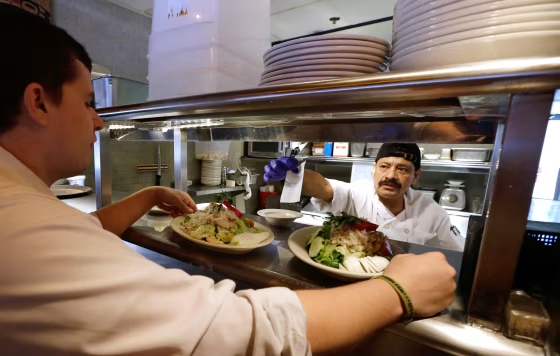
The International Franchise Association, the industry's largest trade group, wants the Supreme Court to take up its challenge to portions of Seattle's $15 minimum wage law.
Seattle's City Council in June 2014 voted to raise the minimum wage in increments, hitting $15 an hour by 2017 for businesses with at least 500 staffers. The $15 level is more than double the federal hourly minimum of $7.25.
The International Franchise Association and five Seattle franchisees quickly sued Seattle, which like New York City has moved to treat smaller franchised businesses like larger companies.
They argued that the mandated $15 pay unfairly lumps franchised businesses with large employers. The association and franchisees want to be recognized as smaller businesses to get more time to raise pay incrementally to $15 by 2021.
How Seattle Franchisees Are Fighting the $15 Minimum Wage
"Our appeal has never sought to prevent the City of Seattle's wage law from going into effect," franchise association President Robert Cresanti said in a statement this week. "Our appeal to the Supreme Court will be focused solely on the discriminatory treatment of franchisees under Seattle's wage law and the motivation to discriminate against interstate commerce."
The association said a response is due from the city of Seattle within 30 days, and the Supreme Court is expected to announce this spring whether it will hear the case.
In March 2015, a federal judge threw out the franchise groups' lawsuit, and the decision was upheld in September by the 9th U.S. Circuit Court of Appeals.
For now, Seattle wages are tiered. The wages range from $10.50 to $13 an hour, depending on the size of the employer and whether the company pays toward medical benefits.
A representative from Seattle Mayor Ed Murray's office could not be immediately reached for comment.







 FOR SUBSCRIBERSA harrowing ordeal aboard an Israel-bound plane






FOR SUBSCRIBERSThe debate over AI’s future rages on both coasts

FOR SUBSCRIBERSA harrowing ordeal aboard an Israel-bound plane
FOR SUBSCRIBERSThe debate over AI’s future rages on both coasts
The impact of higher mandated pay on franchisees is contentious.
New York Gov. Cuomo’s Power Play for $15 Minimum Wage
A recent survey from the conservative Employment Policies Institute, a conservative nonprofit research organization, found franchisees are more harmed than nonfranchised businesses when implementing wage hikes.
The survey of more than 600 businesses found franchisees are more likely to take "offsetting steps including reducing staff, reducing hours and using automation to manage the increased labor costs caused by minimum wage increases" than are nonfranchised businesses.
This trend was more pronounced in the fast food and hotel sectors — more than 80 percent of franchised fast food owners said they would be more likely to reduce hiring, vs. 58 percent of non-fast-food restaurant owners. And nearly 90 percent of franchised hotels said they would raise room rates, compared with 70 percent of nonfranchised hotels.
"Policymakers will compound the damage of a $15 minimum wage by arbitrarily targeting businesses with a recognizable brand for uniquely harsh wage mandates," Michael Saltsman, the Washington, D.C.-based institute's research director, said in a statement.