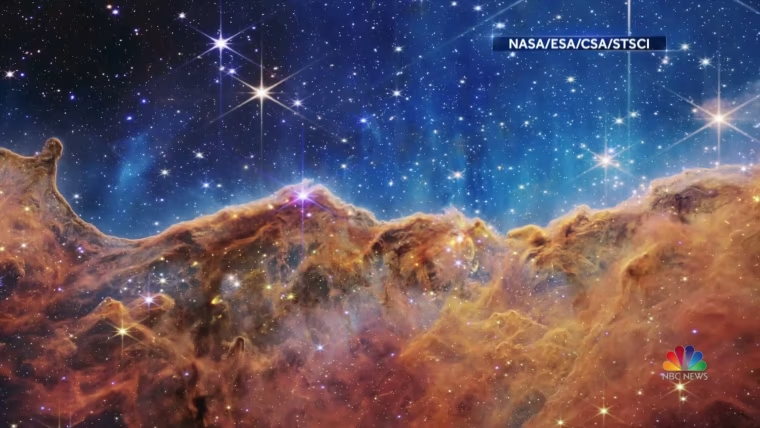
The first images from the James Webb Space Telescope are just a preview of the impressive capabilities of NASA’s $10 billion, next-generation observatory. Billed as the successor to the iconic Hubble Space Telescope, which launched into orbit in 1990, Webb was designed to peer deeper into space than ever before, with powerful instruments that can capture previously undetectable details in the cosmos.
Here’s how the Webb telescope stacks up to its famous predecessor.
Carina Nebula
The Carina Nebula is an active star-forming region located roughly 7,600 light-years away in the constellation Carina. Hubble’s view of the stellar nursery was already stunning, but Webb’s infrared cameras are able to pierce through cosmic dust, revealing previously invisible areas where new stars are being born.
Southern Ring Nebula
NASA officials likened the Southern Ring Nebula, an expanding shell of gas surrounding a star in its final throes, to the last “performance” of a dying star. The Webb telescope captured features of the Southern Ring Nebula in exquisite new detail, including rings of gas and dust expelled in all directions by the dimmer of two stars at its center.
Stephan’s Quintet
Both Hubble and Webb snapped images of a distant group of five galaxies known as Stephan’s Quintet. This band of galaxies is located nearly 300 million light-years away in the constellation Pegasus. Webb’s mosaic reveals some never-before-seen details, including bundles of young stars, active starburst regions and huge shock waves as one of the galaxies smashes through the cluster.
SMACS 0723
Among the Webb telescope’s first images was a spectacular view of a galaxy cluster known as SMACS 0723. Thousands of bright galaxies can be seen speckled across a small patch of sky, including extremely distant celestial objects from the early days of the universe. By comparing Hubble’s and Webb’s infrared images of SMACS 0723, it’s possible to see how the Webb telescope will be able to peer deeper into the universe than ever before, bringing some of the faintest objects in the cosmos into sharp, new focus.

