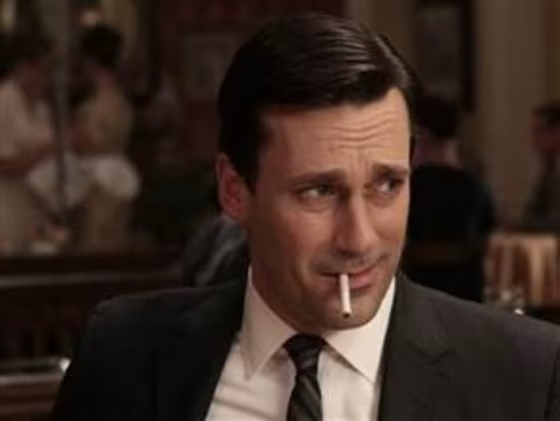
You might know some extremely creative people who are anything but humble about their talents -- the full-of-himself actor, the self-important artist, the vain musician, the pompous writer or -- possibly most annoying of all -- the insufferable ad agency creative type (think Don Draper from "Mad Men").
A new study reveals there may be a kernel of truth to these cultural stereotypes.
The research, published in the journal Personality and Individual Differences, stopped short of labeling creative types as jerks, but it didn't paint a pretty portrait of some aspects of their personalities, either. Psychologists asked more than 1,300 college students to complete a personality test and various creativity questionnaires. The data they collected was self-reported and measured creative abilities mainly in arts, crafts, drama, and creative writing.
The researchers looked at how six different personality traits influenced creativity. They found an openness to experience is the personality characteristic with the largest influence on creativity, a result seen in previous studies. Extroversion had a smaller effect, while emotionality and conscientiousness made no difference.
Agreeableness, which indicates that people can compromise, sympathize and get along well with others, also had no effect. But honesty-humility was shown to have a negative influence on creativity.
"Our research didn't find a huge effect, and we certainly aren't claiming that all creative people are insufferably arrogant but, on average, people with a lot of creative accomplishments were less humble and modest," says Paul Silvia, an associate professor of psychology at the University of North Carolina at Greensboro, and the study's lead author.







 FOR SUBSCRIBERSA harrowing ordeal aboard an Israel-bound plane







FOR SUBSCRIBERSThe debate over AI’s future rages on both coasts

While the creative personality has many appealing traits -- being curious, broad-minded, and open to new experiences -- it has a few unappealing ones, like less modesty and more arrogance, explains Silvia.
FOR SUBSCRIBERSA harrowing ordeal aboard an Israel-bound plane
FOR SUBSCRIBERSThe debate over AI’s future rages on both coasts
But scoring low on honesty-humility characteristics can actually be quite helpful to folks in creative fields. "You're going to have critics and detractors and people who discourage you from pursuing your creative vision," says Silvia. And the farther people get in a creative field, the louder the criticism gets, so it takes some self-assurance to stick with it and take creative risks.
On the flip side, though, creative pursuits often require teachers and mentors to nurture your talents and connect you to people who can get your work out to the public. "So the truly arrogant will have a harder time cultivating the relationships and networks needed to get 'plugged in' to a creative community," points out Silvia.
More creative and less creative people are different in a lot of ways, explains Silvia, and every imaginative person is not a pretentious blowhard. "I suspect that the creative greats can balance genuine grandiosity and genuine humility," he says.