Thousands of salmon, tuna and other fish with electronic tags are revealing mysterious Pacific Ocean migration highways that may give clues about how to rebuild dwindling stocks, scientists with the Census of Marine Life said in an annual report on their work.
Marine experts also found 78 new species of fish in 2005 along with scores of other creatures ranging from a 10-foot-long rocket-shaped jellyfish in the Arctic to a tiny carnivorous sponge in the South Atlantic.
“Fish with chips” — hi-tech implants that enable either satellite or seabed tracking — were one of the breakthroughs to uncover ocean migration paths, scientists in the 73-nation census said.
One bluefin tuna swam the Pacific three times in 600 days according to satellite records — an enormous 25,000 miles, or the distance around the world. That indicated that Japanese and American tuna stocks were one and the same.
“Our studies show that the oceans are a much more complex system than we thought,” said Fred Grassle, chair of the COML steering committee. The census aims to document the oceans as part of efforts to protect marine resources.
Stalking salmon
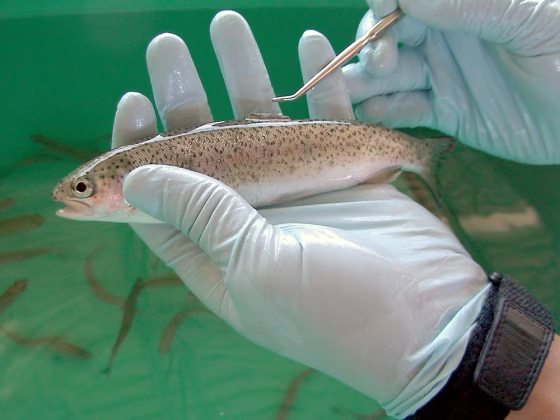
Separately, 2,700 salmon were implanted with electronic chips the size of a little fingernail, up from 1,050 in 2004. They are tracked by seabed stations off North America to see where they go after leaving rivers where they are born.
“Until now salmon have just vanished into the big black box of the ocean,” said David Welch, lead scientist of the project of monitoring stations than run from Washington state to Alaska.
“Salmon stocks have dropped precipitously and this may help us find out why,” he said. The listening arrays would be extended along the whole North American coast by 2010.
Many salmon hugged the continental shelf and fish born in the same river often followed similar routes, he said. In future, trawlers could be ordered to haul in nets if scientists could pinpoint when shoals of endangered salmon were swimming past.
“These tracking systems could be spread worldwide,” said Ron O’Dor, chief scientist of the COML. One plan was to set up seabed monitors for eels and tuna across the entrance of the Mediterranean, while others could track salmon off Europe.
Apart from salmon, about 1,838 animals — including sharks, turtle, tuna, sea lions and birds — have devices that report in by satellite when they go near the surface. The numbers are up by 50 percent from 2004.
The COML, a 10-year project running until 2010, now involves 1,700 scientists.
Jellyfish discovery
Of new species found in 2005, one of the strangest was the rocket-shaped jellyfish known as a physconect siphonophore.
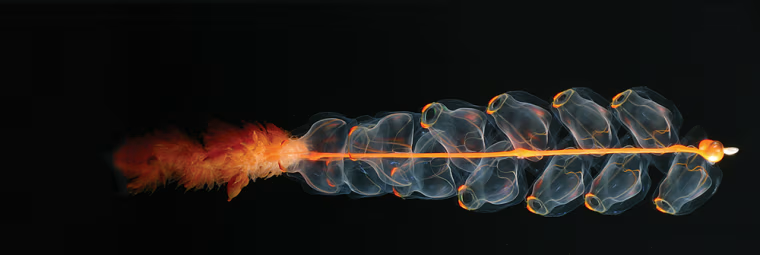
O’Dor said that several pear-shaped jellyfish propelled the long, thin structure containing the orange reproductive organs — like ants working in a colony for a queen.
The discovery of 78 new species of fish, from the depths of the Arctic to the Indian Ocean, raised the total of fish species documented by the COML to 15,717. In total, it has documented 40,000 species of all types — from squid to sea cucumbers — a fraction of the suspected totals.
Among other surveys, scientists found a “dead zone” at the epicenter of the Dec. 26 Indian Ocean tsunami. The COML said that an absence of large animals in a 12,000-foot-deep dive off Sumatra was “unprecedented in 25 years of deep sea sampling.”







 FOR SUBSCRIBERSA harrowing ordeal aboard an Israel-bound plane







FOR SUBSCRIBERSThe debate over AI’s future rages on both coasts

FOR SUBSCRIBERSA harrowing ordeal aboard an Israel-bound plane