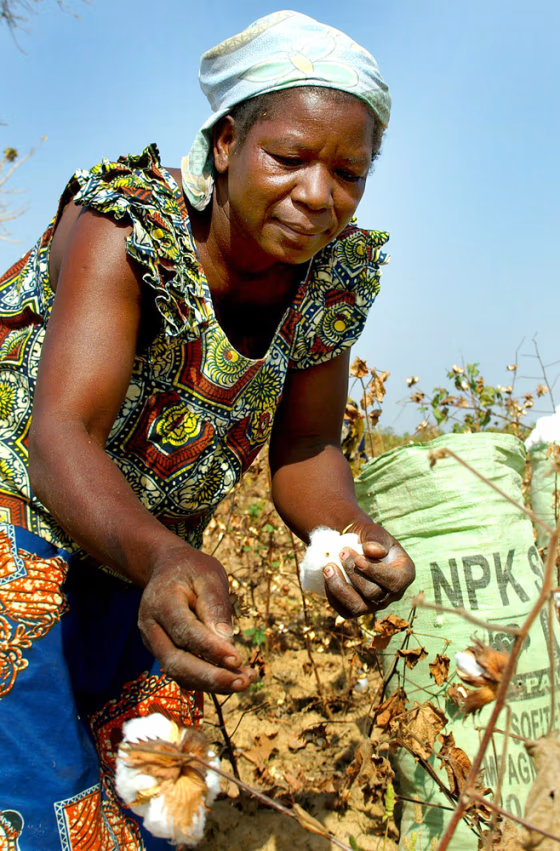
Bent double beneath the harsh midday sun, seven women with babies tightly bound to their backs pluck at clusters of “white gold.”
They have begun the grueling six-month cotton harvest in Burkina Faso, Africa’s largest producer, where 3.5 million people depend on the rise-and-fall of world cotton prices.
Cotton is Burkina’s lifeblood, making up almost a third of the West African country’s economy and more than two-thirds of its exports. A bumper crop of 700,000 tons is expected this year, but that brings little relief to small farmers.
For Kahoun Jean Bosco, who pays the seven women 300 CFA francs (about 55 cents) a day each to labor in his field, subsidies paid by the United States to protect its own farmers are ruining him.
American subsidies ruin prices
“Prices are very tough,” said Bosco. “Last year we were paid 210 CFA francs (about 38 cents) per kilogram (2.2 pounds). This year, it’s 175 CFA francs (about 32 cents). We are going to lose out.”
With eight children to feed, the 56-year-old has been forced to sell his precious maize stores to pay the women. If he is lucky, he may make 300,000 CFA francs ($536) from harvesting his 3.7-acre plot.
The United States, the world’s biggest cotton producer, paid its cotton growers subsidies worth $4.2 billion in 2004 and 2005 — more than Burkina’s whole economy.
African cotton bloc
African producers say this amounts to “dumping” cut-price cotton on world markets. The Association of African Cotton Producers (APROCA) says Africa lost more than $400 million between 2001 and 2003 because of the dumping of subsidized cotton.
At the World Trade Organization (WTO) talks being held in Hong Kong this week, farmers from Africa’s 33 cotton-growing countries will deliver a petition signed by two million people, demanding an immediate end to subsidies.
The WTO has already ruled that U.S. cotton export subsidies are illegal.
West African cotton producers from Benin, Burkina Faso, Chad and Mali want rich nations to halt export subsidies by the end of 2005 and drop 80 percent of other trade-distorting cotton subsidies by a year later.
“The countries of West Africa have the most to gain from a successful outcome to the Hong Kong ...talks,” said U.S. Trade Representative Rob Portman on trip last month to Burkina Faso.
Prices key
Despite doubling cotton production in the last 10 years, Africa’s workers fail to reap the rewards of what they sow.
Subsidies and tariffs deprived Burkina of an estimated 20 billion CFA francs ($35.75 million) in sales last year, according to partially state-owned cotton company Sofitex.
“This is a country that grew by over 5 percent (annually) in real terms for the last 10 years,” said Ellen Goldstein, country manager for the World Bank in Burkina Faso. “The major source of growth has been the expansion of cotton production.”
But land-locked Burkina Faso remains the third least developed country in the world, according to the United Nations. Much stronger growth is needed to tackle poverty.
“Large-scale subsidies by any country to support cotton production will have some pressing effect on world market prices,” Goldstein said. “Barriers to market access, particularly in very big economies, are going to have a negative effect on those that get shut out.”

 FOR SUBSCRIBERSCBP leaders cut out of Trump ad buy decision









FOR SUBSCRIBERSA harrowing ordeal aboard an Israel-bound plane





FOR SUBSCRIBERSCBP leaders cut out of Trump ad buy decision
FOR SUBSCRIBERSA harrowing ordeal aboard an Israel-bound plane
Even growing more cotton does not necessarily deliver higher dividends for strapped farmers.
Due to this year’s record-breaking harvest, workers are in a frantic race to process the crop before the rainy season begins. Ginning machines will run non-stop until the end of the season.
“Head office has asked us to process 500 tons a day, when we are more used to 450,” said Arsene Kompaore, chief of Bobo III cotton processing factory, Burkina’s biggest.
“The aim is to improve the efficiency of the existing machinery. Ideally, we need more investment. But if the world price is very weak, who is going to invest?”
No textile factories at home
During November’s election campaign, President Blaise Compaore’s team used sheets of cotton made in neighboring Niger and Mali to make traditional cloth banners printed with their candidate’s face, because Burkina Faso has no textile factory.
Filature de Sahel (Filsah) is the only factory to spin raw cotton into semi-processed yarn in the country, but lack of investment means it processes only one percent of the cotton.
“The market price has such a great influence,” said Abdoulaye Nabole, director general of Filsah.
He says Burkina’s cotton is widely recognized as the best in the world as it is hand-picked and lacks impurities, but he must sell it for a fraction of its value.
“Subsidies mean we don’t get a fair price: cotton that should sell for 1,300 francs ($2.38) in Europe, I now have to sell for 900 francs *$1.65).”
Africa’s cotton industry will be looking to world trade talks in Hong Kong for signs that its cries for a more equal playing field have been heard. Arsene Kompaore is hopeful.
“The U.S. can’t stop all subsidies immediately, but if they reduce them that will give us enough breathing space to get towards being self-sufficient,” he said. “With new investment I have no doubt we can reach 1 million tons a year.”