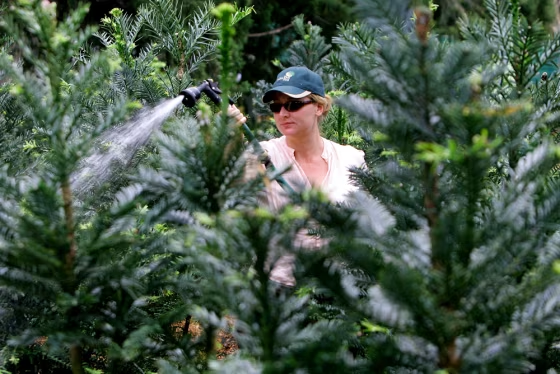
Christmas trees have an apparent plumbing problem.
The fir and pine trees millions of people deck out for the holidays each year — known as conifers — may need all that decoration to make up for their internal shortcomings: The "pipes" they use to distribute water are 10 times shorter than those in flowering trees.
So scientists say conifers should therefore have been driven to extinction millions of years ago by flowering trees and plants, also known as angiosperms, whose plumbing systems are much more efficient.
Yet not only did conifers survive, they thrived: Entire forests in North America are made up of conifers, and both the oldest trees (Bristlecone pines) and the tallest trees (redwoods) are conifers.
So what is the secret to the conifers' survival and success? More efficient valves, a new study finds.
Conifer trees carry water up their woody trunks using tiny, single-celled parallel pipes called “tracheids,” which are about one-eighth of an inch long. In flowering trees, the pipes are made up of several cells and are about 10 times longer.
As a result, water moving up through an evergreen must pass through 10 times as many valves—places where the pipes connect.
To figure out why this is not a problem, researchers measured water flow through twigs from 18 species of conifers and 29 species of angiosperms. To their surprise, they found that for pipes of a given diameter, resistance to water flow in conifers was essentially the same as that in flowering trees.







 FOR SUBSCRIBERSA harrowing ordeal aboard an Israel-bound plane







FOR SUBSCRIBERSThe debate over AI’s future rages on both coasts


FOR SUBSCRIBERSA harrowing ordeal aboard an Israel-bound plane
FOR SUBSCRIBERSThe debate over AI’s future rages on both coasts
It turns out that although conifers having shorter pipes — something that should make water flow more difficult — their valves are much more efficient. Angiosperms, in contrast, have longer, more efficient pipes, but less efficient valves.
The finding is detailed in the Dec. 23 issue of the journal Science.
Conifers and angiosperms evolved two solutions to the same problem, said study leader John Sperry, a biologist from the University of Utah.
"The evolution of the specialized valve and the specialized [pipe] are both ways of achieving more efficient water transport within a tree," Sperry said.
If conifers hadn't evolved this efficient valve system, they would have been at a tremendous disadvantage in the competition for water, in which case your Christmas tree might have had flowers.