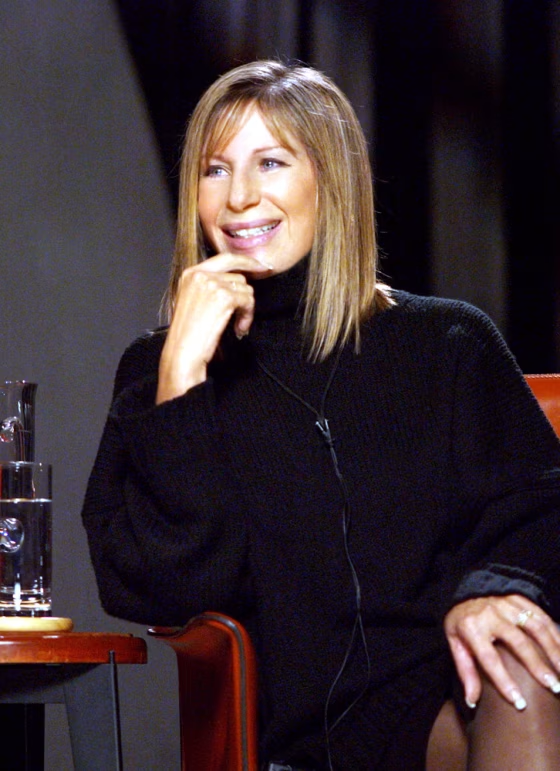
Ironies and anomalies abound on “Barbra Streisand: The Television Specials,” a new DVD collection that marks the first time all five of her great CBS spectaculars have been available on home video. Except for some of the star’s get-ups and hairdos and an occasional technical limitation—and even though they cover the years from 1965 through 1973 -- the specials don’t seem dated at all.
Perhaps the only dead giveaway is that the specials are too good to be new.
Newness, adventurousness and originality nevertheless pervade them all. The complaints a viewer might make are the opposite of common criticisms: The shows aren’t long enough, there isn’t enough repetition (of Streisand’s “greatest hits”), and the production is sometimes too ambitious. Such flaws are easy to live with; the collection is rich and glistening, something to treasure and clasp to your bosom, although it would make more sense to plop the discs into the machine and actually play them.
You don’t have to be the biggest Streisand fan to be enthralled, either. A simple, basic appreciation of showmanship bordering on genius will do.
Each show was considered a big event in its day, the subject of buzz and hoopla before and after the air dates, partly because Streisand achieved the status of legend even before the first one, “My Name Is Barbra,” aired April 28, 1965. Those who were watching then, from front row center in their living rooms, probably still remember the hour’s most high-concept segment: Streisand romping through Bergdorf Goodman’s on Fifth Avenue in a fur coat, off on a singing spree, with the songs chosen to be thematically contrapuntal to the setting.
Surrounded by the lush, luscious and posh, Streisand sang a medley that included “Give Me the Simple Life,” “The Best Things in Life Are Free” and “Nobody Knows You When You’re Down and Out.” Like most of what she’d attempt in the television work to come, this was clever without being too cute. Streisand managed to reinvent songs, to fit them snugly to her own style, without defacing them or taking undue liberties.
Summed up simplistically, her approach was “sing slow songs fast and fast songs slow.” It’s more complex than that, of course, but Streisand’s strikingly fatalistic and defiant “Happy Days Are Here Again”—a song usually performed as a perky picker-upper—still has the power to electrify, to make goose pimples sprout. It is, appropriately, the finale to the first special and the first of the five discs.
By March 1966, when Streisand was ready to do a second special, CBS was ready to spring for color (having lagged behind NBC, then owned by color-set maker RCA), and the producers took full advantage. As with the first special, Streisand broke a number of longstanding rules for this sort of affair: She had no guest stars, she indulged in very little viewer banter, and there was no compromising to make the shows more accessible to Bob and Betty Bowling Alley. The elegance wasn’t snobbish, though, and Streisand, for the most part, avoided being too artsy-smartsy for her own good.
Structured much like the first show, “Color Me Barbra” featured a segment that was shot, with great difficulty, on location—this time, the Philadelphia Museum of Art for a medley bookended by the Jerome Kern classic “Yesterdays.” Streisand has her brightest and most audacious moments in the Egyptian collection, transformed into a nifty Nefertiti for Rodgers and Hart’s “Where or When.”

 FOR SUBSCRIBERSCBP leaders cut out of Trump ad buy decision









FOR SUBSCRIBERSA harrowing ordeal aboard an Israel-bound plane





FOR SUBSCRIBERSCBP leaders cut out of Trump ad buy decision
FOR SUBSCRIBERSA harrowing ordeal aboard an Israel-bound plane
As Marie Antoinette, she sings the “Minute Waltz,” lyrics provided by Ken and Mitzie Welch. Throughout all five programs, it’s usually the “special material” that stands out in a bad way—at times self-conscious and coy. But a medley of songs sung to a small zoo full of animals—“Funny Face” to a pony, “What’s New Pussycat?” to a tiger—comes off nicely. Introducing the medley, Streisand refers to “this new animal called the gerbil”; who knew gerbils were ever new?
Least successful of the specials, at least artistically, was 1967’s “The Belle of 14th Street,” an attempt at an updated vaudeville revue. Streisand shared the screen with Jason Robards, who sings and dances engagingly but is given mediocre material to perform, and the beloved John W. Bubbles, who sings only one number and—since he is billed as “Mr. Chanticleer”—has to do so demeaningly dressed as half-man, half-rooster. What a shameful waste of Bubbles’s talents.
In a taped introduction to “A Happening in Central Park,” which first aired in 1968, Streisand calls it “my third special.” It’s her fourth, and one has to wonder if she made a mistake in counting—unlikely—or whether she simply preferred that “Belle of 14th Street” be forgotten. Even “Belle” was not without highlights, however, the highest being a tender medley of turn-of-the-century period pieces “My Melancholy Baby,” “I’m Always Chasing Rainbows” and “My Buddy/How About Me?”
“Central Park” is essential Streisand, a magnum opus performed outdoors before 150,000 people. When the crowd takes over and sings a verse or two of “Second Hand Rose,” Streisand jokes, “You don’t need me.” On such an occasion, Streisand could not possibly escape without singing “People” from her Broadway hit “Funny Girl.” She also reprises “Happy Days Are Here Again.” But the surprise among the closing ballads is the Christmas carol “Silent Night.”
Finally, “Barbra Streisand . . . and Other Musical Instruments” ends the collection on a grand scale, an extravagant production taped at Elstree Studios in London. The understated theme of the special, about which little else is understated, is that music is a universal language, and the point is made partly by assembling an orchestra of more than 100 pieces. The exotic instrumentation includes bagpipes, tom-toms, banjos and a musical saw. Ray Charles poignantly joins Streisand for the show’s middle portion, and their two-part harmony on “Crying Time” is a sublime collaboration.
“Musical Instruments” aired in 1973 and brought to a close Streisand’s CBS years. From the closest close-up to the most longest long shot, Streisand is the camera’s magnificent obsession—striking, stunning and drop-dead gaw-juss. And to think she can sing, too. In “Funny Girl,” as Fanny Brice—but also as herself—she sang “I’m the greatest star, I am by far, but no one knows it.” Well, we know it now, and this auspicious collection of her TV work belabors the obvious in fabulous fashion.