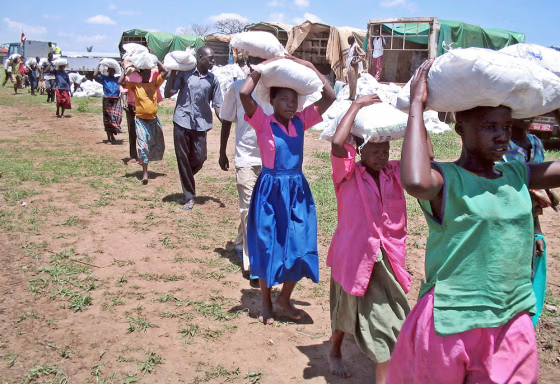
Sitting in a camp for villagers forced from their homes by two decades of war in northern Uganda, 20-year-old Alfred Ojok says he won’t be voting for President Yoweri Museveni in next week’s election.
Like many of the 1.6 million people uprooted by one of Africa’s most brutal conflicts, he blames the southern former rebel commander for failing to end the fighting.
“We want change,” Ojok says. “We cannot remain living like this ... Unless the Museveni people steal our votes, we are expecting a big win here for the opposition.”
Time for a change
Museveni became president the year Ojok was born.
His rivals in the February 23 vote — the first multi-party polls in two decades — have toured the north’s squalid camps, promising to end what the United Nations says is one of the world’s most neglected humanitarian disasters.
Almost the entire population of this region is crowded into cramped settlements, fearful of attacks by notoriously brutal Lord’s Resistance Army (LRA) rebels who roam the deserted forests and rolling grasslands around them.
Every night, 30,000 children trudge into towns to sleep, not wanting to run the risk of being kidnapped by the cult-like group of rebels, who massacre civilians, slice the lips off survivors and have seized some 20,000 children.
The rest of Uganda has largely prospered under Museveni but in the last poll in 2001, he only won 18 percent of the vote in parts of Acholiland, one of the worst affected northern areas.
This time, support for the opposition, particularly Kizza Besigye’s Forum for Democratic Change (FDC), is again running high in the North, although opinion polls put Museveni — once a darling of Western donors, but now accused by critics of becoming more autocratic —firmly in the lead in a countrywide count.
‘Vigilantes’
Besigye, Museveni’s former doctor and one-time ally, won easily in the north five years ago, but was defeated overall.
He fled into exile, but returned in October. In November, he was charged with treason for conspiring with rebels, including the LRA. He denies the charges and has been on the campaign trail since he was released on bail early last month.
Besigye has received a raucous welcome in the camps and dusty towns of northern Uganda like Gulu, where his supporters echo Ojok’s fears that opposition votes will be stolen.
“In the camps, our support is there,” said Paul Ochan, the FDC regional taskforce coordinator. “We need to protect it.”
As aid agencies’ white four-wheel-drive cars and green army trucks rumble past the office, he says FDC is pushing ahead with plans to hire “vigilante” youth brigades to monitor polling stations on election day — despite government protests.
He says moving between the more than 200 camps scattered up to the Sudanese border has been dangerous, and he accuses the army of not giving opposition campaigners enough protection.
Human Rights Watch (HRW) said on Tuesday that the polls were unlikely to be free or fair because of state harassment of the opposition. Uganda’s government said some of the issues raised in the HRW report were “blatantly inaccurate.”
War crimes
The army denies any political bias, and says it has taken extra steps to ensure voting will be free and fair. For the first time, it says, soldiers will vote in public.

 FOR SUBSCRIBERSCBP leaders cut out of Trump ad buy decision








FOR SUBSCRIBERSA harrowing ordeal aboard an Israel-bound plane





FOR SUBSCRIBERSCBP leaders cut out of Trump ad buy decision
FOR SUBSCRIBERSA harrowing ordeal aboard an Israel-bound plane
Whoever wins the presidency will have few options for restarting peace talks with the LRA rebels, whose leaders are wanted for war crimes by the International Criminal Court.
Despite the challenges, all the candidates have said they know how to end the conflict. But beyond vague talk of truth and reconciliation commissions, there have been few specifics.
“It is not enough to tell people, with or without sincerity, 'Give us your votes, I shall take you home,' without explaining how you intend to do it,” says Father Carlos Rodriguez, a veteran peace campaigner in Gulu.
Highlighting the desperate living conditions in the north, more than 3,000 of the tightly-packed thatched huts at one camp in Kitgum district were razed by fire this month, just hours before Museveni visited for a campaign rally.
As thick black smoke drifted over the camp, the president promised to pay about $30 to each family who lost a home, and officials from his Movement party said they would investigate whether the blaze had been started on purpose.
Frequent campaign jingles on local FM radio stations praise Museveni’s efforts to end the war, his amnesty offer to the rebels and his efforts to create more jobs. But the mood at the offices of the president’s party in Gulu is subdued.
In a dark room inside, returning officer George Ovola predicts a Movement victory in the north, and rejects claims that his Acholi people, the north’s main ethnic group, have been marginalized under Museveni’s rule.
“Look at the roads, schools and hospitals built up here despite the war. If he is our enemy, how come he gave us a university?” Ovola says. “We don’t need change because Uganda is not yet stable. If he leaves it will confuse us more.”
Hopes pinned on change, any change
But many in the North have pinned their hopes on Besigye even if they are unsure how exactly a new leader will help them.
At Coo Pe camp, Ojok shields his eyes from the fierce sun to study a poster of Besigye before recounting how his parents were killed five years ago by LRA rebels armed with machetes.
He now fends for himself and three younger sisters.
“My biggest concern is getting enough water and firewood to cook the small food we get,” he says. “I don’t know if Besigye can end this war really ... but our situation is becoming too serious, too serious.”