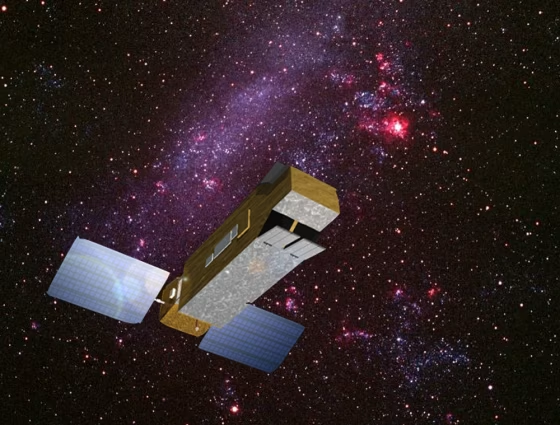
A NASA telescope is operating normally again after a mishap nearly ended its mission two years ago, scientists said Thursday.
The orbiting telescope called FUSE — Far Ultraviolet Spectroscopic Explorer — returned to full strength last month after engineers fixed the problem with its onboard software control system, said William Blair of the Johns Hopkins University, who is part of the project.
"The old satellite still has some spunk," Blair said in a statement.







 FOR SUBSCRIBERSA harrowing ordeal aboard an Israel-bound plane







FOR SUBSCRIBERSThe debate over AI’s future rages on both coasts

Launched in 1999, FUSE views objects by splitting light into thousands of spectra, or bands. So far, the telescope has detected a circle of hot gas surrounding the Milky Way, and found evidence of molecular hydrogen in Mars' atmosphere.
FOR SUBSCRIBERSA harrowing ordeal aboard an Israel-bound plane
FOR SUBSCRIBERSThe debate over AI’s future rages on both coasts
In 2001, two of the telescope's four reaction wheels, which control its direction, failed, but resumed again two months later. In 2004, a third reaction wheel stopped spinning.
FUSE is managed by NASA's Goddard Space Flight Center.