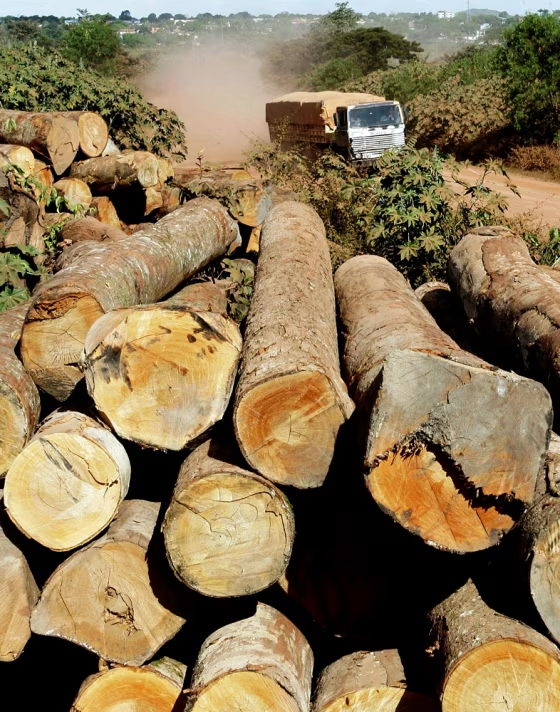
Computer models show that about 40 percent of the Amazon rainforest will be lost by 2050 unless more is done to prevent what could become one of the world’s worst environmental crises, scientists said Wednesday.
Enforcing existing laws and preserving public wildlife reserves will not be enough. Measures are also needed to protect rainforests from the impact of profitable industries such as cattle ranching and soy farming, they added.
“By 2050, current trends in agricultural expansion will eliminate a total of 40 percent of Amazon forests, including six major watersheds and ecoregions,” Britaldo Soares-Filho, of the Universidade Federal de Minas Gerais in Brazil, said in a report in the journal Nature.
A watershed is an area of land where all of the water that is under it or drains from it goes into the same place. It supplies water and habitats for plants and animals.
Soares-Filho and his colleagues used computer models to simulate what would happen to the Brazilian rainforests in the future under different scenarios.
“For the first time, we can examine how individual policies ranging from the paving of highways to the requirement for forest reserves on private properties will influence the future of the world’s largest tropical forest,” Soares-Filho said in a statement.







 FOR SUBSCRIBERSA harrowing ordeal aboard an Israel-bound plane







FOR SUBSCRIBERSThe debate over AI’s future rages on both coasts

Without further checks, the scientists predict nearly 100 native species will be deprived of more than half of their habitats and about 772,300 square miles of forest will be lost.
FOR SUBSCRIBERSA harrowing ordeal aboard an Israel-bound plane
FOR SUBSCRIBERSThe debate over AI’s future rages on both coasts
But if more is done to control expansion and increase protected areas, 73 percent of the original forest would remain in 2050, and carbon emissions would be reduced, the models projected.
The scientists said better conservation of the rainforest would have worldwide benefits, so developed countries should be willing to pay to make it possible.
“By building a policy-sensitive crystal ball for the Amazon, we are able to identify the most important policy levers for reconciling economic development with conservation,” said Daniel Nepstad, a co-author of the study who leads the Amazon program of the Woods Hole Research Center in Massachusetts.