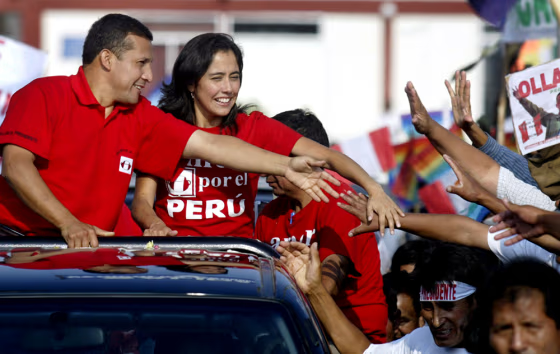
By foot, on horseback and crammed into old trucks, supporters chase Peru’s presidential front-runner Ollanta Humala as he waves from his campaign car, roused by his promises of nationalist revolution.
As honking horns drown out the former army commander’s campaign songs, one message is clear: Humala’s support is rising across rural Peru before the April 9 vote, even as the country’s media, politicians and businesses warn that he is a dangerous radical.
With less than two weeks to go until election day, Humala, campaigning to put Peru’s economy in state hands, looks set to win enough support to go through to a run-off in May between the top two candidates.
“We are the quiet force built up by five centuries of exploitation, tired of living under the dictatorship of the rich and ready to build a new motherland,” Humala told 10,000 supporters in the southern city of Tacna, some holding large photos of leftist Venezuelan President Hugo Chavez.
“I want a revolution, one that gives Peru’s riches to the poor,” Humala told Reuters.
Chavez, an outspoken critic of U.S. policy who says he is waging a leftist revolution in Venezuela, has said Humala’s victory would be “a second independence for Peru.”
Humala wants to rewrite the constitution to give the state control of Peru’s mining and natural gas output, the main drivers of the economy. He would also levy a windfall tax on companies with “excessive” profits and industrialize production of coca, the raw material for cocaine, as a health product.

 FOR SUBSCRIBERSCBP leaders cut out of Trump ad buy decision









FOR SUBSCRIBERSA harrowing ordeal aboard an Israel-bound plane





Such rhetoric, which alarms foreign investors who helped Peru’s economy grow 7 percent last year, inspires dancing and marching bands in towns neglected by successive governments and which lack running water and hospitals.
Facing a prod-business rival
It is also the kind of reaction Humala’s main challenger, center-right lawyer and business favorite Lourdes Flores, struggles to encourage outside Lima, where her main support base of middle class voters lies.
According to the latest Apoyo poll, Humala has 33 percent of voter support, climbing 8 points since early February, compared to Flores’ 27 percent, but not enough to avoid a runoff. Former President Alan Garcia of the center left is in third place with 22 percent.
FOR SUBSCRIBERSCBP leaders cut out of Trump ad buy decision
FOR SUBSCRIBERSA harrowing ordeal aboard an Israel-bound plane
But with a third of voters still undecided and polls not reaching the remotest Andean and jungle regions where Humala’s support is strong, pollsters and political analysts say Humala has more momentum than Flores and Garcia.
Flores’ support has fallen 10 points since late January.
As Humala’s support has risen, outgoing President Alejandro Toledo has warned voters that a Humala government could be disorderly and potentially authoritarian.
Peru’s respected newspaper El Comercio this month published a front-page editorial cautioning people not to vote for Humala, and pro-business newspaper El Correo has dubbed his Union por el Peru party “fascist.”
That appears to have increased Humala’s “outsider” status.
Humala is tapping into frustration at Toledo and other politicians elected in 2001 promising jobs and prosperity for the poor, who make up half of Peru’s 27 million population.
Despite one of the best economic growth rates in South America since 2002, illiteracy remains at 35 percent in remote Andean towns, and one in every two Peruvians has no access to proper medical care.
“I’m voting for Humala to protest against those bastard politicians in Lima who’ve given us nothing but broken promises,” said Ramiro Sueros, 54, a retired military officer at Humala’s rally in Tacna.