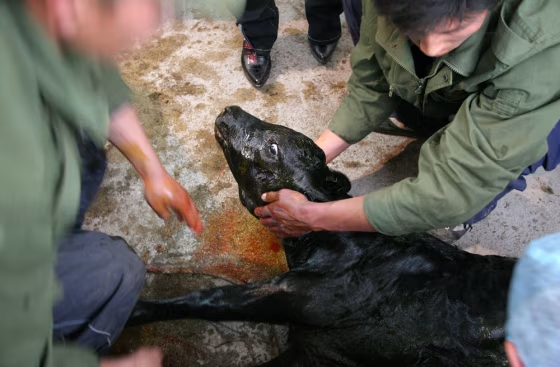
Chinese scientists have succeeded in cloning a cow with genes for resistance to mad-cow disease, the official Xinhua news agency said on Wednesday.







 FOR SUBSCRIBERSA harrowing ordeal aboard an Israel-bound plane







FOR SUBSCRIBERSThe debate over AI’s future rages on both coasts

The birth of the 121-pound (55-kilogram) calf in the eastern province of Shandong comes three years after a team led by now-disgraced South Korean scientist Hwang Woo-suk cloned cows with a protein structure resistant to mad-cow disease, also known as bovine spongiform encephalopathy or BSE.
"Scientists with the Laiyang Agro-Science Institute in Shandong said they used gene-transplant technology to introduce the genes to the calf cloned from cells of an adult cow," Xinhua said.
FOR SUBSCRIBERSA harrowing ordeal aboard an Israel-bound plane
FOR SUBSCRIBERSThe debate over AI’s future rages on both coasts
The research was led by Dong Yajuan and Bo Xuejin — who succeeded in cloning China's first and second healthy cows in 2001 — in collaboration with a Japanese university.
State television reported that further tests would be required on the calf as it grows to verify the effectiveness of the transplanted genes.