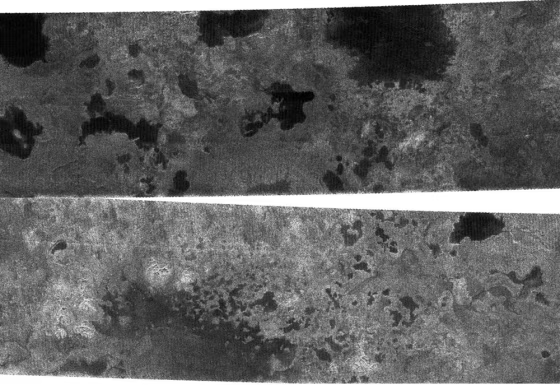
Scientists said Monday they have found the first widespread evidence of giant hydrocarbon lakes on the surface of Saturn's planet-size moon Titan.
The cluster of lakes was spotted near Titan's frigid north pole during a weekend flyby by the international Cassini spacecraft, which flew within 590 miles of the moon.
Researchers counted about a dozen lakes six to 62 miles wide. Some, which appeared as dark patches in radar images, were connected by channels, while others had tributaries flowing into them. Several were dried up, but the ones that contained liquid were most likely a mix of methane and ethane.
"It was a real potpourri," said Cassini scientist Jonathan Lunine of the University of Arizona.
Titan is one of two moons in the solar system known to possess a significant atmosphere similar to that of primordial Earth. But scientists have long puzzled over the source of its hazy atmosphere rich in nitrogen and methane.
Scientists believe methane gas breaks up in Titan's atmosphere and forms smog clouds that rain methane down to the surface. But the source of methane inside the moon, which releases the gas into the atmosphere, is still unknown, Lunine said.
















Last year, Cassini found what appeared to be a liquid hydrocarbon lake about the size of Lake Ontario on Titan's south pole. But the recent flyby marked the first time the spacecraft spied a multitude of lakes.
Cassini's next Titan encounter will be Sept. 7, when it will be 620 miles away.
Cassini, funded by NASA and the European and Italian space agencies, was launched in 1997 and took seven years to reach Saturn to explore the ringed planet and its many moons. The mission is managed by NASA's Jet Propulsion Laboratory in Pasadena.
Cassini's accompanying probe, Huygens, developed and controlled by the ESA, touched down on Titan in 2005.