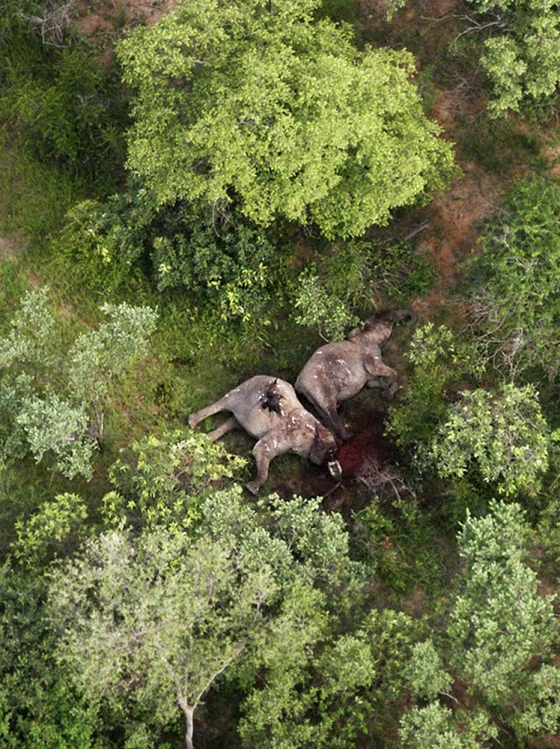
The remains of 100 African elephants killed for their tusks have been found in Chad not far from Sudan’s troubled Darfur region, conservationists said on Wednesday.
The discovery was made earlier this month by a team led by Mike Fay, a renowned conservationist and explorer with the Bronx Zoo-based Wildlife Conservation Society and National Geographic.
“His team discovered five separate elephant massacre sites totaling 100 individuals during a survey made Aug. 3-11 from their small plane,” the Wildlife Conservation Society said in a statement.
WCS said most of the animals had their tusks removed and more than 50 of them appeared to have been slain just days before the team found their carcasses.
The discoveries were made near Chad’s Zakouma National Park, one of the animal’s most northern ranges in central Africa.
“Zakouma is only about 150 miles west of the conflict area of Darfur and is in the path of recent rebel activity in Chad, thus security is low and borders are porous in this isolated region,” WCS said.
An expedition in 2005 counted 3,885 elephants in Zakouma but a year later researchers could find only 3,020.

 FOR SUBSCRIBERSCBP leaders cut out of Trump ad buy decision









FOR SUBSCRIBERSA harrowing ordeal aboard an Israel-bound plane





Wildlife groups say a rise in illicit ivory sales globally is being driven by new demand from China. Elephants are especially at risk in lawless or violence-prone regions where their tusks are a ready source of income.
FOR SUBSCRIBERSCBP leaders cut out of Trump ad buy decision
FOR SUBSCRIBERSA harrowing ordeal aboard an Israel-bound plane
With the exception of occasional one-off auctions in southern Africa, there has been a global ban on ivory sales since 1989, allowing elephant populations in many parts of Africa to recover.
Sprawling across nearly 1,900 square miles, Zakouma is a rare refuge for wildlife in central Africa. Within the park’s borders elephants are protected by the Chadian government with assistance from the European Union. But WCS said the elephants were vulnerable to poaching in the wet season when they forage outside the park’s borders.
The Darfur conflict erupted in 2003 when mostly non-Arab tribes took up arms accusing the Arab-dominated Sudanese government of neglect. The government retaliated by arming mainly Arab militia, known as Janjaweed, but Khartoum says it is not responsible for their campaign of murder, rape, and plunder.