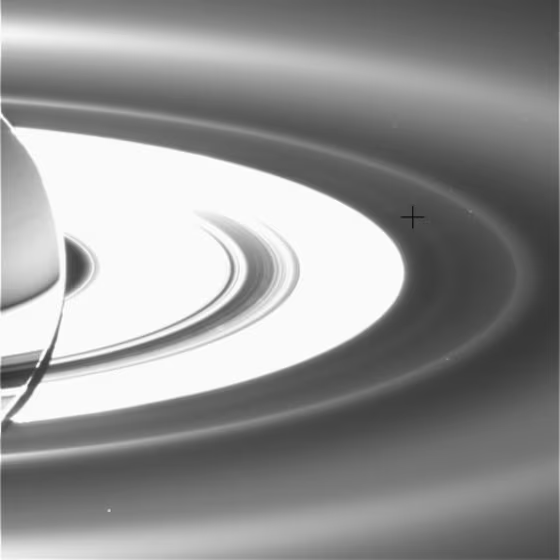
Saturn has a newly discovered ring, a faint trail of particles just visible in between some of its better-known rings, NASA said Tuesday.
The orbiting Cassini spacecraft caught sight of the ring and other rare features when the sun passed directly behind Saturn in what is known as an occultation, providing bright backlight to the rings.
Cameras aboard Cassini also caught images of wispy fingers of icy material stretching out tens of thousands of miles (kilometers) from Enceladus, another confirmation that the moon is spraying material that may be making up Saturn's outer E ring.
Saturn has at least 47 known moons and at least seven rings. The joint U.S.-European Space Agency Cassini mission, launched in 1997, is spending four years examining Saturn.
The new ring can be barely seen outside the brighter main rings of Saturn and inside the G and E rings. It coincides with the orbits of Saturn's moons Janus and Epimetheus, and NASA researchers said that meteoroid impacts on those moons may have kicked off particles that coalesced into the ring.
"Both the new ring and the unexpected structures in the E ring should provide us with important insights into how moons can both release small particles and sculpt their local environments," said Matt Hedman, a research associate at Cornell University in Ithaca, N.Y.







 FOR SUBSCRIBERSA harrowing ordeal aboard an Israel-bound plane







FOR SUBSCRIBERSThe debate over AI’s future rages on both coasts

Cassini also caught a color picture of Earth, which appears to be a pale blue orb, nearly 930 million miles or 1.5 billion kilometers away.
FOR SUBSCRIBERSA harrowing ordeal aboard an Israel-bound plane
FOR SUBSCRIBERSThe debate over AI’s future rages on both coasts
"Nothing has greater power to alter our perspective of ourselves and our place in the cosmos than these images of Earth we collect from faraway places like Saturn," said Carolyn Porco, Cassini imaging team leader at the Space Science Institute in Boulder, Colo.
The images can be seen on the Internet at http://www.nasa.gov/cassini or http://saturn.jpl.nasa.gov and http://ciclops.org.