Investigators sought Saturday to determine why safety rules didn’t prevent a high-speed magnetic train from powering up and speeding into a maintenance vehicle still on the elevated test track, killing 23 people.
Alexander Retemeyer, a prosecutor speaking for investigators, said they were focusing on what happened in the 20-mile track’s control center, where the required two employees were on duty.
“What we are looking into is why the train was given the go-ahead even though the maintenance vehicle was on the track,” Retemeyer said.
Friday’s crash near Lathen in northwestern Germany was the first involving a train using magnetic levitation, or maglev, in which the train rides on a magnetic field without touching rails. The lack of friction allows speeds as high as 270 miles per hour.
Maintenance logs examined
The controllers were supposed to go through several layers of checks to make sure the maintenance vehicle was off the track after its daily inspection, Retemeyer said. Only then were they to turn on the electricity enabling the train driver to start, he said.
Investigators examined the control room log book and discovered the maintenance truck was where it was supposed to be.
It headed out at 8 a.m. and was logged at a spot called Point 120 on the track at 9:53 a.m. when the train started its high-speed run. Fifty-eight seconds later, the train hit the truck at 105 mph. Officials previously said the train was going 125 mph.
Controllers had several ways to determine if the maintenance vehicle was on the track: the log book, a video check of its shed and a GPS satellite navigational device that showed the car as a green dot on one computer system — but not the main security system showing the train’s location.
Workers to be interviewed
Controllers were also supposed to get a radio call from other workers confirming the inspection vehicle was out of the way. Video cameras around the track would not have alerted the controllers because the spot where the maintenance vehicle stopped is in a gap in coverage, he said.
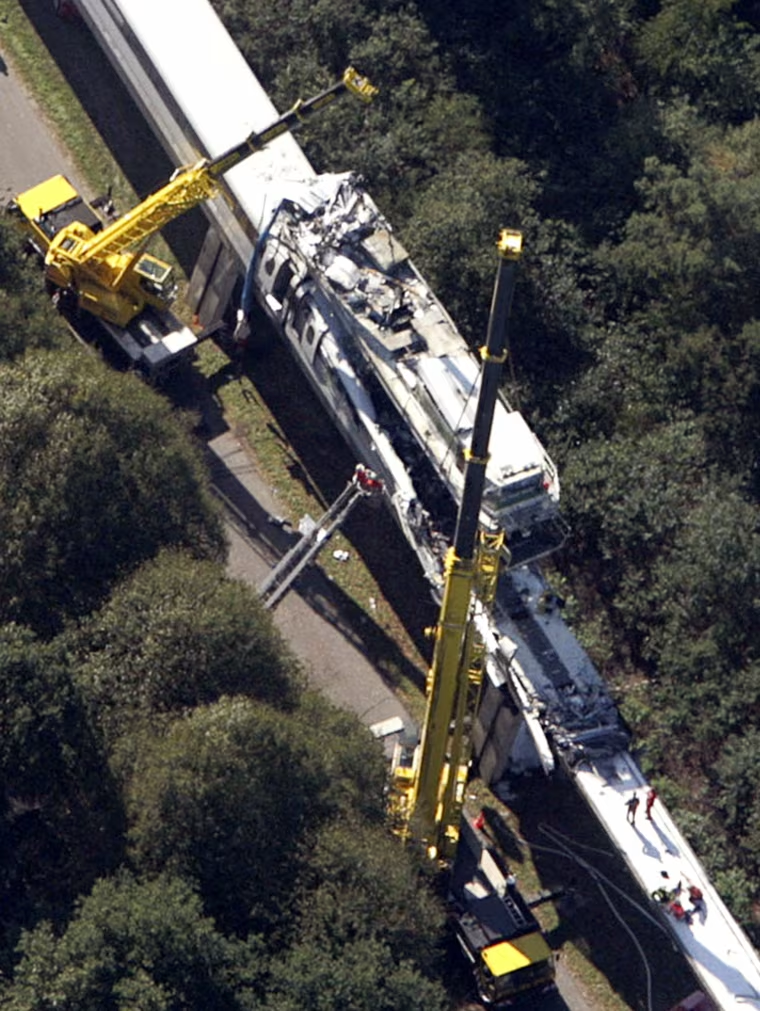
Further interviews will determine whether anyone told the maintenance crew to return to the shed before the train came down the track, Retemeyer said. The two control center employees had not been interviewed because they were in shock and undergoing care, he said.
More information was expected from two workers on the service vehicle, a train driver and a technician who were among the 10 injured survivors. Local officials said none of the survivors had life-threatening injuries.
“At this point, we believe the main reason is that the maintenance vehicle was not integrated into the train security system,” Retemeyer said. “Safety for the maintenance vehicle is the responsibility of people, and so far we have not been able to determine any individual suspects because only now do we know the timeline of what happened.”







 FOR SUBSCRIBERSA harrowing ordeal aboard an Israel-bound plane







FOR SUBSCRIBERSThe debate over AI’s future rages on both coasts

FOR SUBSCRIBERSA harrowing ordeal aboard an Israel-bound plane
FOR SUBSCRIBERSThe debate over AI’s future rages on both coasts
Primarily a demonstration ride
The maintenance car was hit by the low nose of the speeding train and flung up, ripping open the top of the first car of the train and strewing mangled seats, shards of glass and twisted metal parts to the ground 12 feet below.
Among the dead were two young people who had completed an apprenticeship at a company working on the maglev train and were taking the ride as a reward, officials said.
Officials said others included workers for Transrapid International, the joint venture of Siemens AG and ThyssenKrupp AG that makes the train, and one person from IABG, which operates the track.
The track is mainly used to show off maglev technology, but tourists had been allowed to ride the train on its test runs.
There are only two commercially operating maglev trains in the world — in Shanghai, China, and outside Nagoya, Japan. Officials in Germany are studying the possibility of a line between Munich and its airport.
Wu Xiangming, head of China’s maglev project, visited the crash site Saturday, officials said.