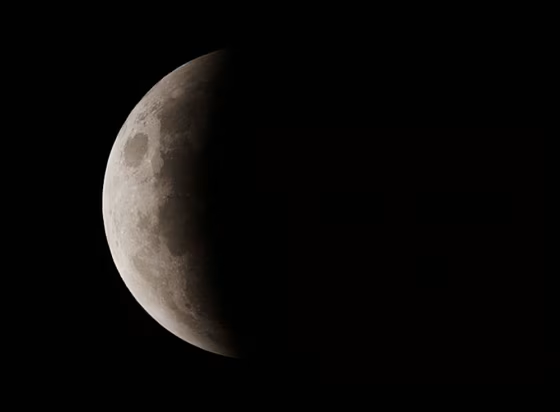
Soon after sunset on Saturday evening, March 3, skywatchers in eastern North America can watch the rising full moon undergoing its first total eclipse in nearly 2-½ years.
In Europe and Africa the eclipse takes place late at night high in a dark sky.
For North Americans, the farther east you are the better. The eclipse will already be in progress when the sun sets and the moon rises, two events that happen almost simultaneously on a lunar eclipse night.

 FOR SUBSCRIBERSCBP leaders cut out of Trump ad buy decision









FOR SUBSCRIBERSA harrowing ordeal aboard an Israel-bound plane





FOR SUBSCRIBERSCBP leaders cut out of Trump ad buy decision
FOR SUBSCRIBERSA harrowing ordeal aboard an Israel-bound plane
In New England and the Canadian Maritime Provinces the moon rises before total eclipse begins; be on the watch for a thinning sliver of the moon’s edge coming up just above the eastern horizon. Across much of the eastern United States, the moon rises during totality. In this region, depending on just how clear your eastern sky is on eclipse evening, you might have to wait a half-hur or more after the moon rises, since the twilight sky will still be quite bright and the full moon will be shining 1/10,000 to 1/100,000 as bright as it normally would; you’ll be hunting for a dim ball.
Across the Midwest, and the Plains States totality has already ended by moonrise and the eclipse is partial as the moon emerges from the Earth’s shadow. In the Rocky Mountain States, only a vague hint of the eclipse may be evident in the form of a tarnishing or smudginess on the moon’s disk. This will be the faint outer shadow of the Earth (the penumbra); it may give the appearance that the “Man in the moon” has a bruise over his left eye. Meanwhile, the West Coast misses out entirely.
The moon will track across the northern portion of the Earth’s shadow, and will be completely immersed for one-hour and 14 minutes, making this a somewhat longer than normal totality.
Slideshow 12 photos
Month in Space: January 2014
Because some of the sunlight that strikes our Earth is diffused and scattered by our atmosphere, its shadow is not completely dark; enough of this light reaches the moon to give it an eerie coppery glow even when it’s totally eclipsed. It is anticipated that during the upcoming total eclipse the moon will glow brightest across its upper portion, while its lower part (closest to the center of the shadow) will appear a darker shade of brown or chocolate color.
This will be the first of two total lunar eclipses in 2007, the other occurring on Aug. 27 will favor western North America and the Pacific Rim.