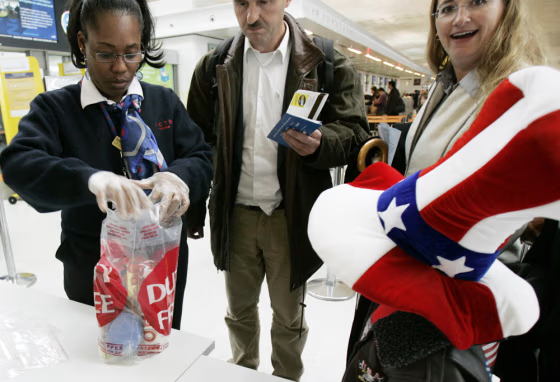
Air passengers with transit connections in the European Union are pouring thousands of liters of alcohol and perfume down the drain every day because of differing security procedures for duty-free goods.
Industry groups say millions of euros are being wasted as travelers hand over bottles of vodka, whisky and other items to airport security officials who cannot tell whether the goods were purchased in secure, duty-free zones.
So serious is the problem that the International Civil Aviation Organization (ICAO), a U.N. agency that oversees international air travel, will host talks next week to seek a global solution.
New EU regulations introduced last November limit passengers to carrying small containers of liquids or gels in sealed plastic bags that are no larger than one liter on board planes.
Those measures were agreed among the 27-nation EU, the United States, Canada, Norway and Switzerland.
But the security rules for duty-free articles vary. Shops selling large bottles of liquids beyond security checkpoints at EU airports must put the products into special, sealed bags that are recognized throughout Europe.
Passengers who buy liquids at duty-free shops outside the EU and make a European stopover before their final destination do not comply with those rules.
















A passenger from Singapore, for example, who flies to Paris via Frankfurt would have to surrender any liquid duty-free goods in Germany before boarding the plane for France.
“We’re hopeful that we can have an overall method on the international level to try to tackle this problem,” said Michele Cercone, a spokesman for EU Transport Commissioner Jacques Barrot. The EU would seek bilateral agreements with other nations if an international standard could not be set.
Duty-free mountains
Failure to find a solution will continue to cost producers, retailers and consumers millions of euros, industry groups said.
“Europe’s butter mountains are now being replaced by duty-free mountains,” one industry official said, comparing the problem with EU surpluses of butter which have to be stored and sold at subsidized prices.
The European Travel Retail Council (ETRC), which represents Europe’s duty-free stores, said sales worldwide have plummeted 40 percent since November.
“An impact assessment is currently being carried out, but we estimate that around 1,500 liters are dumped every day at a cost of around 25,000 euros each day at each airport across the region,” an ETRC spokesman said.
The alcohol industry is also worried it will lose profits from the lucrative duty-free market.
“Our members are very concerned that consumers will shy away from buying duty-free, which is a super premium market with high margins,” a spokesman for European spirits lobby CEPS said.
The Association of European Airlines said it was considering a “tamper-free bag” for duty-free items acceptable worldwide.
The lack of worldwide rules could lead to more inconsistency across the globe, adding expense for airlines and consumers.
Australia will impose extra screening for airlines flying from countries whose measures are not “considered equivalent to Australian measures”, a draft law obtained by Reuters says.
Sean O’Neachtain, an Irish member of the European Parliament’s transport committee, called that move “draconian”.
“The airline has to pay for these people to screen, so in the end the consumer will pay for the increased cost via increased ticket prices. But add to that the extra inconvenience and loss of time, it will be a nightmare,” he said.