With climate change now adding to the pressures, sharing rather than warring over the world's resources of fresh water represents the "challenge of the 21st century," the United Nations said Thursday as it marked World Water Day.
"The bulk of that challenge lies in finding more effective ways to conserve, use and protect the world’s water resources," the U.N. Food and Agriculture Organization said in a statement.
Already 1.1 billion people lack access to adequate clean water and, with the world's population set to grow from the current 6.5 billion to 8 billion by 2030, 1.8 billion people will face water scarcity by then, the Rome-based agency estimated.
That growing population also means that "14 percent more freshwater will need to be withdrawn for agricultural purposes in the next 30 years," the FAO stated.
FAO Director Jacques Diouf said the repercussions of not meeting the challenge would be enormous. "Water conflicts can arise in water stressed areas among local communities and between countries," he told a conference marking World Water Day.
"The lack of adequate institutional and legal instruments for water sharing exacerbates already difficult conditions. In the absence of clear and well-established rules, chaos tends to dominate and power plays an excessive role," he said.
Warming 'raised the stakes'
The FAO added that "climate change has raised the stakes" since some studies indicate that warming temperatures might cause more frequent droughts as well as more intense storms and flooding, "which destroy crops, contaminate freshwater and damage the facilities used to store and carry that water."
"Particularly vulnerable to climate variability," the FAO said, are the world's poorest farmers, who "often occupy marginal lands and rely on rainfall to sustain their livelihoods."
In a report on the state of the world's water resources, the FAO concluded that "climate change is expected to account for about 20 percent of the global increase in water scarcity. Countries that already suffer from water shortages will be hit hardest."
The agency also cited a 2006 study by Britain's weather agency concluding that with no mitigation of climate change, the severe droughts that now occur only once every 50 years would occur every other year by 2100.
To improve cross-border cooperation on water use, the 10 countries on the Nile River are negotiating a water sharing agreement that the FAO hopes will be a model for other areas where the scarce resource can be shared peacefully.
Polluted water victim: Great Barrier Reef
The pressures on water resources include chemical runoff from farms into rivers, contaminating water supplies and even ocean resources.
In Australia, the conservation group World Wide Fund for Nature on Thursday urged the government to take action to protect the Great Barrier Reef, which is already being stressed by warming waters, from such run-off.
Scientists last month warned of the run-off, and other researchers earlier warned that the 1,400-mile-long coral reef — the world's largest living structure — could be functionally extinct by 2050 due to global warming, taking with it a $4.5 billion tourist industry.
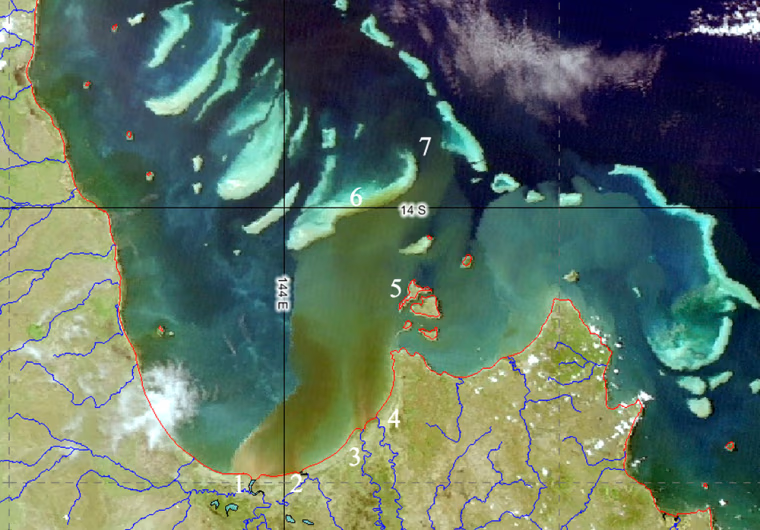
But the reef was actually facing a twin threat, with chemical run-off from farms along the coast of Queensland state threatening to trigger an attack by predatory Crown-of-Thorns starfish, who thrive on farm waste, WWF said in a report.
"It is reducing the reef's resilience to climate change. The risk is farm pollution will feed another outbreak of this invasive species, which devastates reefs and can halve coral cover," said WWF water expert Nick Heath.
The starfish, which lives on tiny living polyps which make up the reef, can each wipe out up to six meters of coral each year and scientists believe agricultural run-off can help it to thrive.







 FOR SUBSCRIBERSA harrowing ordeal aboard an Israel-bound plane







FOR SUBSCRIBERSThe debate over AI’s future rages on both coasts

FOR SUBSCRIBERSA harrowing ordeal aboard an Israel-bound plane
FOR SUBSCRIBERSThe debate over AI’s future rages on both coasts
WWF said as many as 700 of the Great Barrier Reef's 3,000 coral outcrops were in danger because of human activity in water catchments along the coast and pesticides used by the sugar cane industry. Diuron and Atrazine — pesticides used by the cane industry — have now been found up to 60 miles offshore, it said.
The reef is home to more than a third of the world's soft corals, more than 1,500 species of fish and six of the world's seven marine turtle species.
WWF alleged that the government had done little to implement a 2003 plan to protect the water quality around the reef.