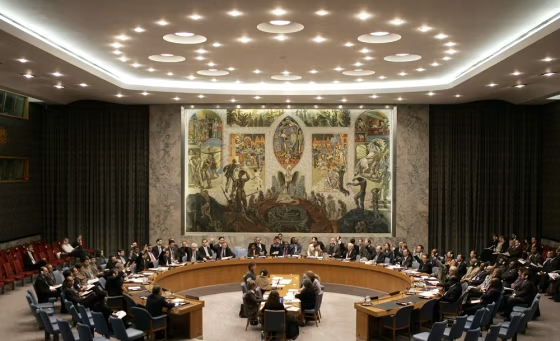
The U.N. Security Council unanimously voted Saturday to impose new sanctions against Iran for its refusal to stop enriching uranium — a move intended to show Tehran that defiance will leave it increasingly isolated.
The moderately tougher sanctions include banning Iranian arms exports, and freezing the assets of 28 people and organizations involved in Iran’s nuclear and missile programs.
About a third of those are linked to the Revolutionary Guard, an elite military corps.
“This resolution sends an unambiguous signal to the government and people of Iran ... that the path of nuclear proliferation by Iran is not one that the international community can accept,” said British Ambassador Emyr Jones Parry.
In December, the 15-member Security Council ordered all countries to stop supplying Iran with materials and technology that could contribute to its nuclear and missile programs. It also ordered a freeze on assets of 10 key Iranian companies and 12 individuals related to those programs.
Tehran remains defiant
Iran has vowed the sanctions will only motivate it further to pursue nuclear power, a message Foreign Minister Manouchehr Mottaki was expected to deliver to the Security Council. Mottaki made the trip instead of Iranian President Mahmoud Ahmadinejad, who claimed he canceled his appearance because the U.S. failed to deliver his visa in time. The U.S. said it had issued the visa promptly.
Speaking before Iran took the floor, U.S. acting ambassador Alejandro Wolff accused Iran of terrorism and the threat by Ahmadinejad to wipe Israel “off the map” and call the Holocaust “a myth.”
“To forget the past, or even worse, attempt to rewrite it is to invite it to be repeated. We cannot allow that to happen,” Wolff said.
Raising tensions, Iran detained 15 British sailors and marines Friday in what it said were Iranian territorial waters near Iraq. The British sailors and marines had been on a mission to search for smugglers in Iraqi waters.
The six world powers that drafted the new resolution spent Friday trying to overcome objections from several council members, reflecting concerns that anything short of consensus would weaken efforts to rein in Iran’s nuclear defiance.
There were several minor concessions but no changes to the key sanctions agreed upon last week by the United States, China, Russia, Britain, France and Germany.
Compromise measure
The new sanctions — already a compromise between the stronger measures favored by the United States and the Europeans and the softer approach advocated by Russian and China — are considered modest. The ban on exports is among the harshest measures, but many of Iran’s arms sales may not be affected because they are illicitly sent to militant groups like Lebanon’s Hezbollah and Shiite militias in Iraq.
Still, world powers hoped that approving the resolution quickly and unanimously would signal that Iran will face stricter sanctions each time it ignores a Security Council deadline to suspend uranium enrichment, a process that can be used to produce nuclear energy or nuclear weapons. Iran responded to the first set of sanctions in December by expanding enrichment.







 FOR SUBSCRIBERSA harrowing ordeal aboard an Israel-bound plane







FOR SUBSCRIBERSThe debate over AI’s future rages on both coasts

Tehran says it will never give up its right to enrich uranium and produce nuclear fuel, though it has offered to provide guarantees that its nuclear program won’t be diverted toward weapons, as the U.S. and some of its allies fear.
FOR SUBSCRIBERSA harrowing ordeal aboard an Israel-bound plane
FOR SUBSCRIBERSThe debate over AI’s future rages on both coasts
Iranian leaders kept up their defiant rhetoric in the days leading up to the vote, with Ahmadinejad calling the Security Council illegitimate and Supreme Leader Ayatollah Ali Khamenei suggesting Iran would pursue nuclear activities outside international regulations if faced with more sanctions.
Arms, travel restrictions
Saturday’s Resolution 1747 may affect Iran’s economy but does not touch on its oil industry. Iran is the world’s fourth largest oil producer.
It imposes an embargo on all conventional weapons Iran can sell and freezes the assets abroad of 28 individuals, institutions and companies, including Bank Sepah, as the United States has already done, isolating it from international financing.
The text calls on -- but does not order -- nations and international financial institutions to restrict new grants, credits and loans to Iran. Western diplomats believe the World Bank and the International Monetary Fund will heed the call.
The resolution also calls for a voluntary travel embargo on Iranian officials and Revolutionary Guard commanders listed in the text and urges restrictions on the import of heavy weapons to Iran.
The resolution asks the International Atomic Energy Agency to report back in 60 days on whether Iran has suspended enrichment and warns Iran could face further measures if it does not. But it also says all sanctions will be suspended if Iran halts enrichment and makes clear that Tehran can still accept a package of economic incentives and political rewards offered last year if it complies with the council’s demands.
To get the support of South Africa, Indonesia and Qatar, they added the importance of a Middle East free of weapons of mass destruction and highlighted the role of the International Atomic Energy Agency.
South Africa’s U.N. ambassador, Dumisani Kumalo, who had submitted amendments that deleted all the sanctions, said he voted in favor because of Pretoria’s opposition to nuclear weapons but criticized the resolution for penalizing Iranian institutions beyond the nuclear sphere.
After the latest resolution met with surprising resistance from several elected Security Council members, a reference was inserted to a past resolution from the IAEA calling for the Middle East to be free of weapons of mass destruction. Indonesia and Qatar had wanted the council to make that appeal outright, but that would have had implications for Israel, a U.S. ally widely believed to possess nuclear weapons, though it has never officially acknowledged it.