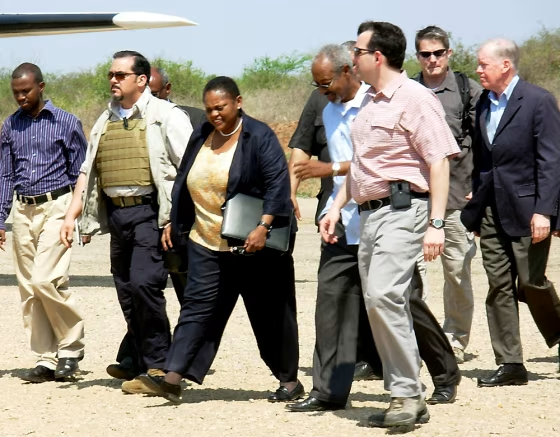
The top U.S. diplomat for Africa urged Somalis on Saturday to leave behind 16 years of bloody conflict and focus on national reconciliation, warning the country has become “a haven for terrorists.”
Assistant Secretary of State for African Affairs Jendayi Frazer made a surprise visit to the Horn of Africa country on the sixth day of a fragile cease-fire between the government and Islamic insurgents. The truce ended a surge in fighting that left hundreds dead and forced thousands of residents to flee Somalia’s capital.
“Somalia, unfortunately, has become a haven for terrorists, and that continues to be a prime concern of the United States of America,” Frazer said at a news conference after meeting President Abdullahi Yusuf Prime Minister Ali Mohamed Gedi.
Speaking later in neighboring Kenya, Frazer said her talks with Somali leaders focused on the need to “build support and legitimacy for the transitional federal government and to isolate the extremists.”
High-level guest
Frazer is the highest-ranking American envoy to visit Somalia since 1993, when rebels brought down two U.S. Black Hawk helicopters in Mogadishu, and then engaged U.S. soldiers in a 12-hour fire fight that left some 300 Somalis dead. The U.S. withdrew a year later.
Frazer had been scheduled to come to Somalia in January, but the trip was called off due to security concerns.
Late last year, American special forces helped Somali troops and their Ethiopian backers push out the Islamist fighters, who had taken over the capital and surrounding region. The U.S. says the Islamists were harboring al-Qaida members.







 FOR SUBSCRIBERSA harrowing ordeal aboard an Israel-bound plane







FOR SUBSCRIBERSThe debate over AI’s future rages on both coasts

Frazer said the insurgents were not interested in talking with the government and were receiving support from neighboring Eritrea and the “global jihadist network.”
“Eritrea is the country of most concern, but it is not the only country,” she said.
Frazer said Washington believes Sheik Hassan Dahir Aweys, the leader of the routed Islamic movement, and Hassan Turki, another top member, were still in Somalia, along with the newly chosen head of Somalia’s al-Qaida cell, Aden Hashi Ayro. Ayro was one of targets of a U.S. airstrike in January in Somalia.
FOR SUBSCRIBERSA harrowing ordeal aboard an Israel-bound plane
FOR SUBSCRIBERSThe debate over AI’s future rages on both coasts
No visit to capital
Frazer flew in Saturday to the government stronghold of Baidoa, an agricultural town 155 miles southwest of Mogadishu, amid extremely tight security. She did not travel to Mogadishu, and left later in the day for Nairobi, Kenya.
The United States is a major financial supporter of the weak transitional Somali government and a small force of African Union peacekeepers, having pledged more than $120 million.
On Friday, a European Union conflict expert said in an e-mail obtained by the AP that Ethiopian and Somali forces may have committed war crimes during heavy artillery shelling against the Islamic insurgency and that foreign donors could be complicit.
The warning was made in an urgent e-mail to Eric van der Linden, the chief EU official for Kenya and Somalia, who confirmed the message’s authenticity to the AP.
President Yusuf and his Cabinet ministers have repeatedly called for civilians to leave their homes because insurgents have fired mortars at Ethiopian and government troops from densely populated neighborhoods.
A local human rights group said more than 1,000 civilians were killed or injured in the four days before the cease-fire — the heaviest fighting in Mogadishu in 15 years.
Frazer condemned the insurgent attacks on the government, and expressed concern over the large number of civilian casualties.
“I think everybody used excessive force, when you talk about the number of civilian casualties it is obvious,” she said.