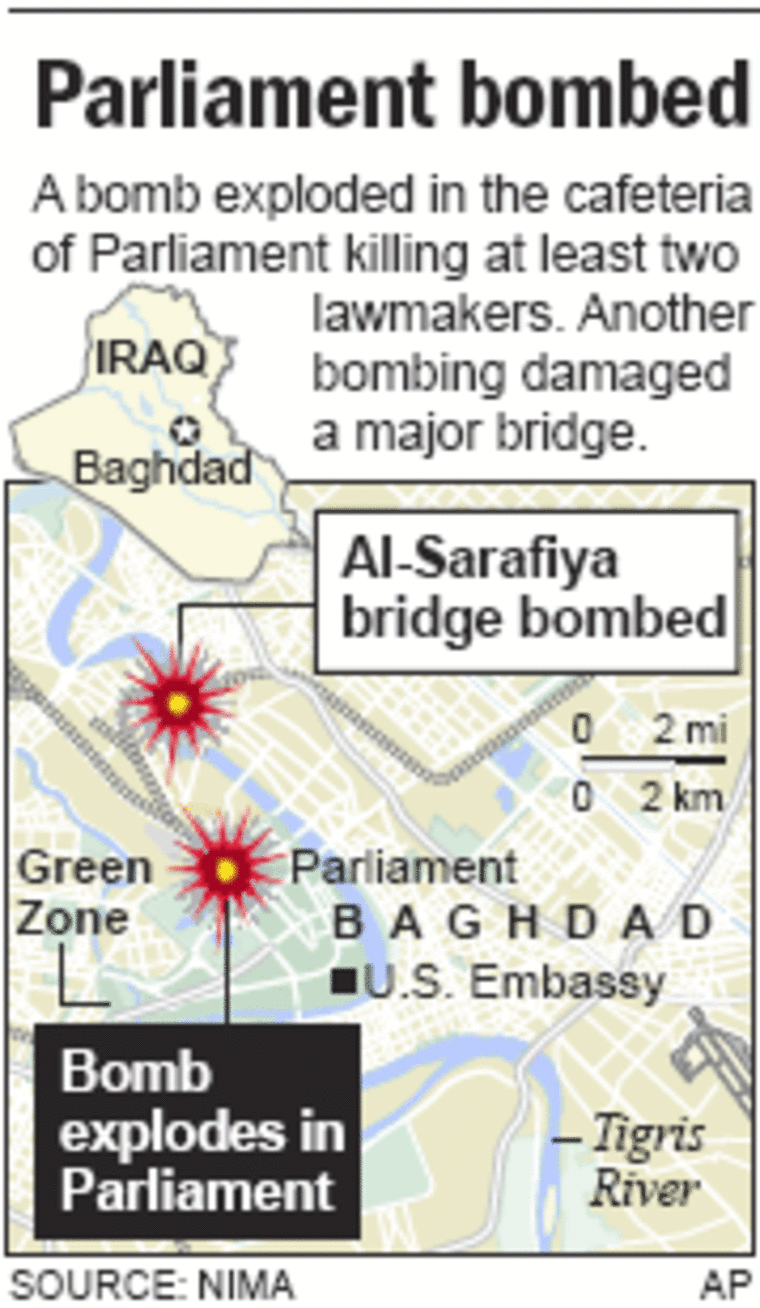
A suicide bomber blew himself up in the Iraqi parliament cafeteria Thursday, killing at least eight people — including three lawmakers — and wounding dozens in a stunning assault in the heart of the heavily fortified, U.S.-protected Green Zone.
A news video camera captured the moment of the blast: a flash and an orange ball of fire causing a startled parliament member who was being interviewed to duck, and then the smoky, dust-filled aftermath of confusion and shouting. The video was shot by Alhurra, a U.S. government-funded Arab-language channel.
The explosion came hours after a , collapsing the steel structure and sending cars tumbling into the Tigris River, police and witnesses said. At least 10 people were killed.
The parliament bombing was believed to be the deadliest attack in the Green Zone, the enclave that houses Iraq’s leadership as well as the U.S. Embassy, and is secured by American and Iraqi checkpoints.
Security officials at parliament, who spoke on condition of anonymity because they were not authorized to release the information, said they believed the bomber was a bodyguard of a Sunni member of parliament who was not among the dead. They would not name the member of parliament.
The officials also said two satchel bombs were found near the cafeteria. A U.S. bomb squad took the explosives away and detonated them without incident.
White House, State Dept. comments
In Washington, President Bush strongly condemned the attack, saying: “My message to the Iraqi government is ‘We stand with you.”’
“We know that there is a security problem in Baghdad,” Secretary of State Condoleezza Rice, said at the State Department. “This is still early in the process and I don’t think anyone expected that there wouldn’t be counterefforts by terrorists to undermine the security presence.”
Maj. Gen. William Caldwell told The Associated Press that eight people were killed in the attack, which witness accounts indicated was carried out by a suicide bomber.
Iraqi officials said the bomber struck the cafeteria while several lawmakers were eating lunch, and at least three of them — two Sunnis and a Shiite — were killed. State television said 30 people were wounded.
“We don’t know at this point who it was. We do know in the past that suicide vests have been used predominantly by al-Qaida,” Caldwell said.
Echoing the general, a senior U.S. intelligence official told NBC News on Thursday that the attack “is the work of al-Qaida in Iraq.”
“The safe working assumption, based on what we're seeing with targeting and timing is that it's all al-Qaida,” said the official.







 FOR SUBSCRIBERSA harrowing ordeal aboard an Israel-bound plane







FOR SUBSCRIBERSThe debate over AI’s future rages on both coasts

FOR SUBSCRIBERSA harrowing ordeal aboard an Israel-bound plane
FOR SUBSCRIBERSThe debate over AI’s future rages on both coasts
Government spokesman Ali al-Dabbagh suggested that those behind the attack might work in the building.
“There are some groups that work in politics during the day and do things other than politics at night,” he told Alhurra.
Video captures blast
The Alhurra video showed the blast, with startled lawmaker Jalaluddin al-Saghir, who is also a Muslim imam, ducking for cover. It then showed the immediate aftermath: People screamed for help in a smoky hallway, with one man was slumped over, covered in dust, motionless. A woman kneeled over what appeared to be a wounded or dead man near a table. The camera then focused on a bloody, severed leg.
TV cameras and videotapes belonging to a crew sending footage to Western networks were confiscated and apparently handed over to U.S. authorities.
After the blast, security guards sealed the building and no one — including lawmakers — was allowed to enter or leave.
A spokesman for the U.S. Embassy in Baghdad said no Americans were hurt.
The bombing came amid the two-month-old security crackdown in Baghdad, which has sought to restore stability in the capital so that the government of Iraq can take key political steps by June 30 or face a withdrawal of American support.
Shiite, Sunni lawmakers killed
The dead lawmakers were identified by colleagues as Mohammed Awad of the Sunni National Dialogue Front, Taha al-Liheibi of the Sunni Accordance Front and Niamah al-Mayahi of the Shiite United Iraqi Alliance bloc. A female lawmaker of the Sunni National Dialogue Front was wounded, according to her party leader.
Mohammed Abu Bakr, who heads the parliament’s media department, and other lawmakers said they saw the suspected bomber’s body amid the ghastly scene.
“I saw two legs in the middle of the cafeteria and none of those killed or wounded lost their legs — which means they must be the legs of the suicide attacker,” he said.
Earlier in the day, security officials used dogs to check people entering the building in a rare precaution — apparently concerned that an attack might take place.
A security scanner for pedestrians at the entrance to the Green Zone near the parliament building was not working, and people were searched only by hand and had to pass through metal detectors, Abu Bakr said.
Green Zone penetrable
The brazen bombing was the clearest evidence yet that militants can penetrate even the most secure locations. Masses of U.S. and Iraqi soldiers are on the streets in the ninth week of a security crackdown in the capital, and security measures inside the Green Zone have been significantly hardened.
The U.S. military reported April 1 that two suicide vests were found in the Green Zone, also home to the U.S. Embassy and the Iraqi government. A rocket attack last month killed two Americans, a soldier and a contractor. A few days earlier, a rocket hit within 100 yards of a building where U.N. Secretary-General Ban Ki-moon was holding a news conference. No one was hurt.
Ban said Thursday’s attack “attempted to undermine one of the country’s sovereign institutions,” and he urged Iraqis to come together in unity to work for peace, said U.N. deputy spokeswoman Marie Okabe.
Khalaf al-Ilyan, one of three leaders of the Iraqi Accordance Front, said the attack “underlines the failure of the government’s security plan.”
“The plan is 100 percent a failure. It’s a complete flop. The explosion means that instability and lack of security has reached the Green Zone, which the government boasts is heavily fortified,” said al-Ilyan, who is in Jordan recovering from knee surgery.
Catastrophe averted?
Hadi al-Amiri, head of the parliament’s security and defense committee, said the blast shook the building just after legislators ended their main meeting and broke into smaller committees.
“A few brothers (fellow lawmakers) happened to be in the cafeteria at the time of the explosion,” al-Amiri told Al-Arabiya television. “But had they been able to place this bomb inside the meeting hall, it would have been a catastrophe.”
Hours after the bombing, Deputy Prime Minister Barham Saleh and other Iraqi officials met with the commander of all U.S. forces in Iraq, Gen. David Petraeus, and decided to put the Interior Ministry in charge of security at parliament, al-Dabbagh said. The building was previously guarded by a private security company, he said.
Petraeus also said the U.S. military extended condolences to those “martyred” in the bombing.
New U.S. Ambassador Ryan Crocker called the attack a “heinous act of terrorism.”
“This cowardly attack is an attempt to undermine the efforts of all who are working to build a peaceful, unified, and stable Iraq. It will not succeed,” he said.
A rare event, but not unheard of
Attacks in the Green Zone are rare. The worst previous known assault occurred Oct. 14, 2004, when a blast at a market and a popular cafe killed six people — the first bombing in the sprawling region.
On Nov. 25, 2004, a mortar attack inside the zone killed four employees of a British security firm and wounded at least 12. On Jan. 29, 2005, insurgents hit the U.S. Embassy compound with a rocket, killing two Americans — a civilian and a sailor — on the eve of landmark elections. Four other Americans were wounded.
In addition to killing 10 people, Thursday’s bombing of the al-Sarafiya bridge wounded 26, hospital officials said, and police were trying to rescue as many as 20 people whose cars plummeted off the span.
Waves lapped against twisted girders as patrol boats searched for survivors and U.S. helicopters flew overhead. Scuba divers donned flippers and waded in from the riverbanks.
The wake-up bomb
Farhan al-Sudani, a 34-year-old Shiite businessman who lives near the bridge, said the blast woke him at dawn.
“A huge explosion shook our house and I thought it would demolish our house. Me and my wife jumped immediately from our bed, grabbed our three kids and took them outside,” he said.
The al-Sarafiya bridge connected two northern Baghdad neighborhoods — Waziriyah, a mostly Sunni enclave, and Utafiyah, a Shiite area.
Police blamed the attack on a suicide truck bomber. AP Television News video showed the bridge broken in two places — perhaps the result of two blasts.
The al-Sarafiya bridge is believed to be at least 75 years old, built by the British in the early part of the 20th century.
“It is one of Baghdad’s monuments. This is really damaging for Iraq,” said Ahmed Abdul-Karim, who lives nearby. “We are losing a lot of our history every day.”
The river now serves as a de facto dividing line between the mostly Shiite east and the largely Sunni west of the city, a reality of more than a year of sectarian fighting that has forced Sunnis to flee neighborhoods where they were a minority and likewise for Shiites.
Also Thursday, the U.S. military said its troops killed two suspected insurgents and captured 17 in raids across the country.