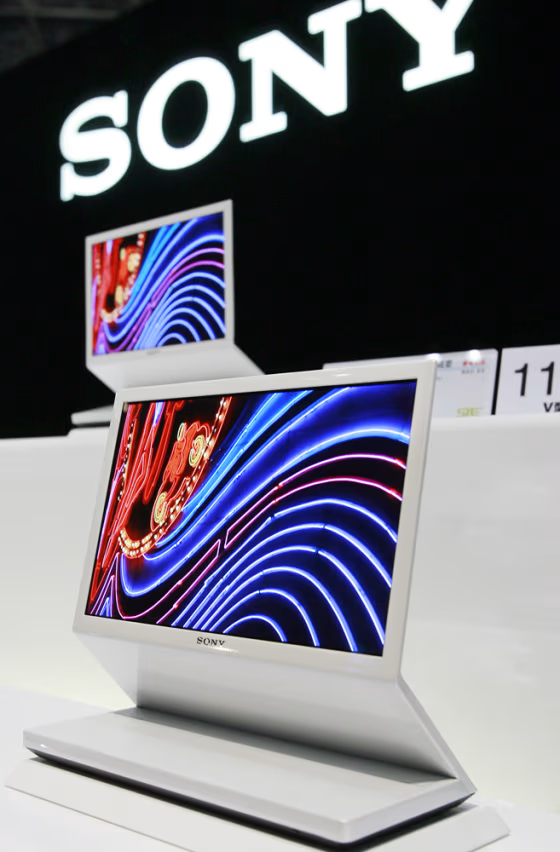
Sony Corp. said on Thursday it planned to start selling ultra-thin TVs using organic light-emitting diode (OLED) technology this year, aiming to become the first to market with a TV using the promising next-generation display.
Several companies are investing in OLED technology because it can produce bright, colorful images and does not require a backlight as do liquid crystal displays (LCDs), allowing for a thinner panel. OLED panels are also said to be energy-efficient and good at reproducing fast-moving images.
At a display forum in Tokyo, customers, suppliers and even rival TV makers turned their backs on 50-inch and bigger TVs to throng before Sony's tiny 11-inch OLED TVs.
"LCD and plasma displays look faded in comparison," said a Denso Corp. employee who declined to be named, fighting to take a picture of the new TVs.
OLED displays are already used in digital cameras, cellphones and other devices with relatively small panels. But cost and technology hurdles have so far prevented them from being mass produced for use in larger equipment such as TVs.
The OLED TV to be launched this year will be made by ST Liquid Crystal Display Corp., a joint venture between Sony and Toyota Industries Corp., Sony spokesman Daiichi Yamafuji said, declining to give unit targets or a likely price.
Sony has invested aggressively in LCD technology and is now the world's largest player in the LCD TV market. It makes big LCD panels in a joint venture with South Korea's Samsung Electronics
"It won't be easy for OLED TVs to replace LCD TVs, but we would like to turn OLED TVs into a big new business," Sony Executive Deputy President Katsumi Ihara said in a speech at the display forum.







 FOR SUBSCRIBERSA harrowing ordeal aboard an Israel-bound plane







FOR SUBSCRIBERSThe debate over AI’s future rages on both coasts

FOR SUBSCRIBERSA harrowing ordeal aboard an Israel-bound plane
FOR SUBSCRIBERSThe debate over AI’s future rages on both coasts
The Nikkei business daily reported earlier that Sony would begin by mass-producing about 1,000 of the 11-inch OLED sets a month -- a fraction of its LCD TV business -- and would aim to keep their price within a few times that of existing flat TVs.
Competitive prices
"OLED sets are very expensive, and we mean to begin first by marketing the TVs as a status symbol," said Sony's Kazuhiro Imai, a senior manager of the company's TV and Video business group. "We will see where the business goes from there."
Ihara said Sony slightly exceeded its target of selling 6 million LCD TVs in the business year ended last month, and reiterated a target to sell 10 million units this year.
Other companies investing in OLED displays include Seiko Epson Corp., Canon Inc., Samsung and a joint venture between Toshiba Corp. and Matsushita Electric Industrial Co.
Toshiba President Atsutoshi Nishida said on Thursday the company hoped to make larger TV-use OLED panels at the joint venture, Toshiba Matsushita Display Technology Co., by 2009, taking aim at the $35 billion flat TV market, which is currently dominated by LCD and plasma display technology.