With a tiny, high-tech scale, researchers can now weigh living bacteria and immune cells for the first time.
In traditional methods of weighing, molecule are placed on top of a tiny silicon slab inside a vacuum.
The slab vibrates at its natural frequency until the molecule is placed on top, when the frequency changes slightly. The mass of the molecule can be calculated by measuring the change.
But living cells cannot survive in a vacuum and must be measured in a fluid, which would interfere with the measurement if it surrounded the slab.
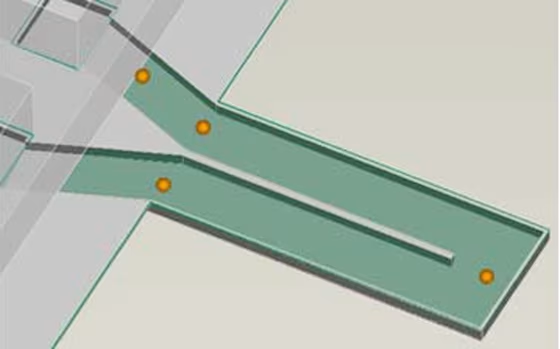
A group of MIT scientists solved this problem by pumping the fluid containing the sample of cells through a microchannel inside the slab.
The scale can now measure living cells and nanoparticles down to a femtogram, or about the weight of an E. coli bacterium.
The technique could help researchers develop inexpensive, portable diagnostic devices that could help health workers in developing countries; for example, a device could be created to count CD4 immune cells in AIDS patients, which would tell how far the disease has progressed.







 FOR SUBSCRIBERSA harrowing ordeal aboard an Israel-bound plane







FOR SUBSCRIBERSThe debate over AI’s future rages on both coasts


FOR SUBSCRIBERSA harrowing ordeal aboard an Israel-bound plane
FOR SUBSCRIBERSThe debate over AI’s future rages on both coasts
“A cheap, simple CD4 counting device that can be used by a community health worker would be a breakthrough advance in global health,” said William Rodriguez, an AIDS researcher at Massachusetts General Hospital who was not affiliated with the research.