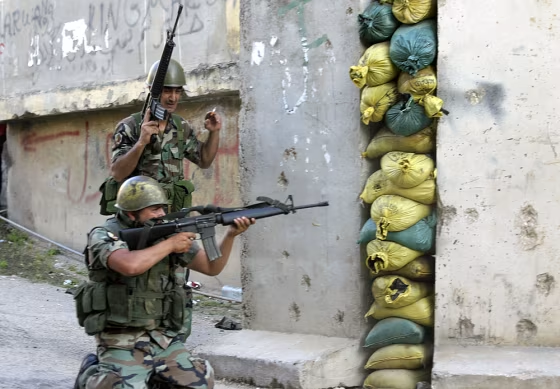
Lebanese troops fought Islamic militants in a northern Palestinian refugee camp and clashed with another group in a southern camp Monday as the violence spawned by a two-week-old confrontation with al-Qaida-inspired fighters appeared to be spreading.
Two Lebanese soldiers were killed in fighting in the Ein el-Hilweh refugee camp in southern Lebanon between troops stationed outside the camp and Jund al-Sham militants.
At the same time, Fatah Islam continued its 16-day standoff against the army in the Nahr el-Bared Palestinian refugee camp on the outskirts of this northern Lebanese port city. The overnight exchanges tapered by the morning.
Police said five Lebanese soldiers were wounded in the southern fighting by rocket-propelled grenades and machine-gun fire in clashes that have continued on and off since late Sunday. There was no word on militant casualties at Ein el-Hilweh, the largest of Lebanon’s 12 Palestinian refugee camps.
In the north, fighting resumed Monday morning after an overnight lull. The army has been pounding Fatah Islam positions at Nahr el-Bared since May 20 and has moved tanks and armored carriers into the camp in a push to crush the al-Qaida-inspired militants who refuse to surrender.
Many in Lebanon believed the army would be able to crush the Fatah Islam inside Nahr el-Bared quickly, but after three days of fierce battles using artillery and tanks, the troops continued to face strong resistance.
Will violence spread in Palestinian refugee camps?
The relentless bombardment has angered Palestinians in some of the country’s 11 other refugee camps, a possible recipe for spreading violence.

 FOR SUBSCRIBERSCBP leaders cut out of Trump ad buy decision









FOR SUBSCRIBERSA harrowing ordeal aboard an Israel-bound plane





The Lebanese government has demanded that Fatah Islam surrender, but the militant group’s deputy leader rejected the call in a telephone interview with The Associated Press.
“This is not only impossible, this is unthinkable. Our blood is cheaper than handing over our weapons and surrendering,” Abu Hureira, a Lebanese whose real name is Shehab al-Qaddour, said Sunday. He also denied the army had made significant progress in its offensive.
“I am still in the same position since the war began,” Abu Hureira said. “Our morals are high and the army did not make any advance.”
Lebanese security officials, speaking to The Associated Press on condition of anonymity because they were not authorized to make statements to media, have said that Nahr el-Bared had been strategically divided into three zones. The army was controlling one zone and the militants held another, while Palestinian civilians and guerrillas controlled the third and were refusing the militants sanctuary, they said.
FOR SUBSCRIBERSCBP leaders cut out of Trump ad buy decision
FOR SUBSCRIBERSA harrowing ordeal aboard an Israel-bound plane
Fatah Islam spokesman Abu Salim Taha, told the AP by cellular telephone that five Fatah Islam members, including a senior leader, have been killed and seven wounded since Friday, when the latest army offensive began.
He also said Fatah Islam militants ambushed an advancing Lebanese force Sunday, pushing it back a few yards amid heavy fighting on the north and northeastern edges of the camp.
A senior Lebanese army officer said nine Lebanese troops have been killed at Nahr el-Bared and several others wounded since Friday.
The casualties raised the army’s death toll to 44 at Nahr el-Bared since the standoff began two weeks ago. At least 20 civilians and about 60 militants have also been killed in the northern Lebanon fighting, but casualties in the camp in the last four days were unknown because relief organizations were banned from entering.
Senior leader reportedly slain
Officials said Sunday that a senior leader of Fatah Islam, Naim Deeb Ghali, who is also known as Abu Riad, had been killed in the fighting.
Abu Hureira confirmed that Ghali was killed Friday, but would not say whether he was a senior Fatah Islam official, referring to him only as “a brother.”
A wounded Palestinian civilian was seen being evacuated from the camp Sunday in a Palestinian Red Crescent Society ambulance. The man, in his 50s, suffered head and shoulder injuries, according to reporters on the scene. Meanwhile, about 30 civilians who live on the southern outskirts of the camp were allowed to leave, the reporters said.
In other the developments, the main road linking Tripoli with the province of Akkar and the Syrian border reopened Sunday for the first time since Friday. Vehicles were seen passing on the road that was closed for two days by Lebanese troops over fears of snipers.