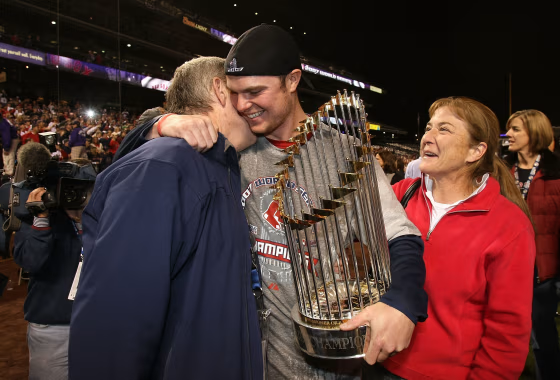
As Boston Manager Terry Francona approached the World Series mound and firmly, but gently, took the baseball from Jon Lester's left hand, he smacked his pitcher on the back so firmly you almost felt it yourself. First baseman David (Big Papi) Ortiz practically hugged the 23-year-old. Rookie second baseman Dustin Pedroia, who's known Lester throughout their trip up through the Boston minor leagues from Portland to Pawtucket, added his slaps.
Finally, the entire Red Sox infield and proud Boston captain Jason Varitek gathered around Lester like a band of big brothers, unashamedly giving him perhaps the most emotional round of congratulations that you will ever see for a pitcher that has, technically, just been knocked out of the game. But, when you pitch 5 2/3 shutout innings to win the clinching game of the World Series just 13 months after you get cancer and spend a winter doing four rounds of chemotherapy, emotions will erupt.
As Lester strode to the dugout here in Game 4, head up and calm, he made a gesture that seemed like annoyance, perhaps because he walked the last batter he faced, rather than the pride bordering on joy that he might justifiably have felt. Behind him, the huge Coors Field scoreboard told the story of one of the most moving and excellent pitchers' duels of any World Series. Boston led Colorado 2-0 with two outs in the sixth inning. Lester had brought his team — bereft of any other plausible starting pitcher after an injury to Tim Wakefield — to the brink of its second World Series sweep in four seasons.
And he had done it 13 months after learning last September, in the midst of a fine rookie season, that he had anaplastic large cell lymphoma.
The story of this night will be retold for many a year, not only because of Lester's excellence but because of the distinguished work of the losing pitcher, Aaron Cook of the Rockies, another emergency starter, who himself returned to baseball after a life-threatening blood clot in his lung three years ago. And if hyperbole's arm is twisted in the process, so be it. The cause is good. Hard as it is to fathom, in a month when even the sharpest of star pitchers fail, Lester hadn't started a game in more than a month and Cook, who turned in a quality start, allowing three runs in six innings, hadn't started in two months.
Despite not starting a single game in more than a month, despite every imaginable excuse for wildness, rustiness or failure, Lester threw 92 pitches, 59 of them for strikes. Almost every low-90s fastball, snapping slider and slower curve arrived precisely where he intended as he held the Rockies to just three hits while walking three and striking out three.
"We all know the story of what Lester has gone through. I'm ecstatic for him," said World Series MVP Mike Lowell, the 33-year-old pro's-pro third baseman who doubled and homered in Boston's 4-3 win. "I don't think too many people thought he would be here. He beat a great hitting team in a tough park for pitchers."
"I'm so proud of Jon, the way he pitched, how composed he was, how he competed," said Francona, who has never hidden that he thinks Lester will be a star pitcher, but perhaps an even finer person with his understated modesty. "It is very appropriate that he got the win."
This has been the October when many of the game's pitching aces have been shellacked as their teams were eliminated — including Chien-Ming Wang of the Yankees, Fausto Carmona and C.C. Sabathia of the Indians and Jeff Francis of the Rockies. Yet Lester, barely at the start of his career, and Cook, a 36-35 journeyman, found the strength to prevail.
Within minutes of Lester's exit, Cook was heading to the Colorado dugout. His departure was just as dignified and appreciated by his teammates. However, Cook left after a solo home run into the left field bleachers by Lowell that gave Boston a 3-0 lead. If anything, Rockies Manager Clint Hurdle may have given in to sentiment by allowing Cook to start the seventh after being idle for so long. Nonetheless, Cook not only pitched well but beat out a bunt hit against Lester and robbed the Red Sox of a hit with a fielding gem.
"I don't think it's a coincidence. This game drips with irony at different times for different reasons," said Hurdle of the pitching matchup. "It's happened because it's happened . . . The significance of it is special for every cancer victim that's out there. There's a battle that can be fought and that could be won.
"So, it's good. It's real good."
That will, without doubt, be the verdict on this night and on the Lester-Cook meeting that may, eventually, be remembered longer than an extremely forgettable World Series. The Red Sox outscored the Rockies, 29-10, after outscoring the Cleveland Indians, 30-5, in winning the last three games of the American League Championship Series to overcome a three-games-to-one deficit. Those seven straight wins, by a 59-15 margin, established beyond doubt that the Red Sox were the class of the sport in '07.







 FOR SUBSCRIBERSA harrowing ordeal aboard an Israel-bound plane







FOR SUBSCRIBERSThe debate over AI’s future rages on both coasts

A star-drenched Boston team, constructed for $145 million to beat the Yankees and everybody else, simply steamrolled a young, modestly talented Rockies team that entered this World Series coming off an eight-day layoff. That hiatus seemed to dissipate all the sharpness and confidence that Colorado shown in its amazing 21-out-of-22-game winning streak to reach its first World Series.
FOR SUBSCRIBERSA harrowing ordeal aboard an Israel-bound plane
FOR SUBSCRIBERSThe debate over AI’s future rages on both coasts
"The Rockies are so classy," said Francona. "I hope nobody forgets that we beat a very good team."
Hot as the Rockies were, until Boston cooled them off, that's just how torrid the Red Sox hitters were in this series with six starters batting between .333 and rookie Jacoby Ellsbury's team-high of .438. However, in lopsided World Series like this — and baseball has now been blighted with three sweeps and a five-game series in the last four Octobers — the personalities of strong individuals tend to be remembered longer than the competitive dynamics of the series. Lester and Cook, in particular, fit this mold. How could two pitchers who could barely remember their last start show such poise, especially when Lester, though a fine prospect with an 11-2 career record, is barely wet behind the years and the obscure Cook has never had a 10-win season?
Yet, before this game, Francona and Hurdle seemed certain as the morning sunrise that Lester and Cook, against all odds, would be in complete control of themselves, masters of all their faculties on the most stressful stage.
"Aaron's perspective on life and on sport has been drastically altered," said Hurdle. "He was put in a position where not only was his sport going to be taken away but so was his life."
"Don't feel sorry for yourself, don't sit at home and think about it," Lester said of his months of chemo and doubt last winter. As he recovered, he also gained insight on his just-completed rookie season. "Last year I didn't really get a chance to enjoy what was going on — being up in the big leagues, being a part of every kid's dream," Lester said. "I took a lot of things for granted last year. And I beat myself up over little things.
"This year, I've tried to just have fun, treat it like a game, like a kid's game."
Only in recent weeks has Lester begun to feel like the pitcher who, just two years ago, was compared by Boston scouts to star closer Jonathan Papelbon, who got the save to close out this World Series and send the Boston Common toward the moon.
"Right now it seems like my fastball has got a little extra on it. It's getting its life back," Lester said.
How appropriate. So is he.