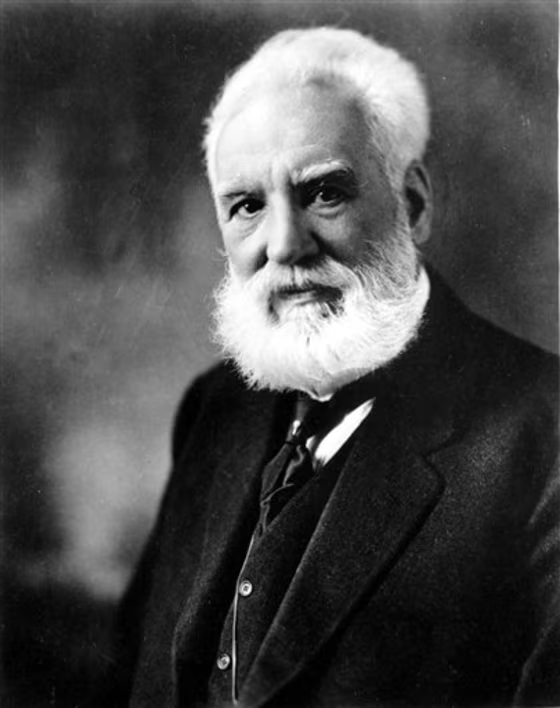
A new book claims to have definitive evidence of a long-suspected technological crime — that Alexander Graham Bell stole ideas for the telephone from a rival, Elisha Gray.
In "The Telephone Gambit: Chasing Alexander Graham Bell's Secret," journalist Seth Shulman argues that Bell — aided by aggressive lawyers and a corrupt patent examiner — got an improper peek at patent documents Gray had filed, and that Bell was erroneously credited with filing first.
Shulman believes the smoking gun is Bell's lab notebook, which was restricted by Bell's family until 1976, then digitized and made widely available in 1999.







 FOR SUBSCRIBERSA harrowing ordeal aboard an Israel-bound plane







FOR SUBSCRIBERSThe debate over AI’s future rages on both coasts

The notebook details the false starts Bell encountered as he and assistant Thomas Watson tried transmitting sound electromagnetically over a wire. Then, after a 12-day gap in 1876 —when Bell went to Washington to sort out patent questions about his work — he suddenly began trying another kind of voice transmitter. That method was the one that proved successful.
As Bell described that new approach, he sketched a diagram of a person speaking into a device. Gray's patent documents, which describe a similar technique, also feature a very similar diagram.
FOR SUBSCRIBERSA harrowing ordeal aboard an Israel-bound plane
FOR SUBSCRIBERSThe debate over AI’s future rages on both coasts
Shulman's book, due out Jan. 7, recounts other elements that have piqued researchers' suspicions. For instance, Bell's transmitter design appears hastily written in the margin of his patent; Bell was nervous about demonstrating his device with Gray present; Bell resisted testifying in an 1878 lawsuit probing this question; and Bell, as if ashamed, quickly distanced himself from the telephone monopoly bearing his name.
Perhaps the most instructive lesson comes when Shulman explores why historical memory has favored Bell and not Gray — nor German inventor Philipp Reis, who beat them both with 1860s telephones that employed a different principle.
One reason is simply that Bell, not Gray, actually demonstrated a phone that transmitted speech. Gray was focused instead on his era's pressing communications challenge: how to send multiple messages simultaneously over the same telegraph wire. As Gray huffed to his attorney, "I should like to see Bell do that with his apparatus."