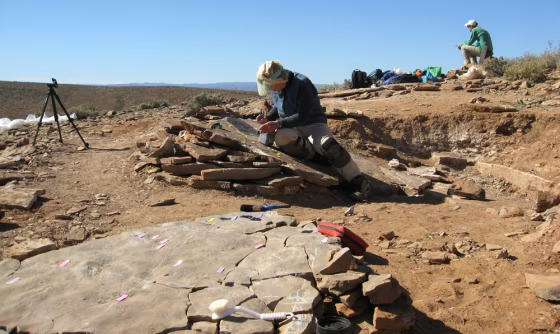
Sexual reproduction may be nearly as old as animal life itself, according to researchers who discovered a new species of organism that lived 540 million years ago.
The tube-like creatures called Funisia dorothea anchored themselves in abundant flocks onto the shallow, sandy seabed of what is now the Australian outback.
Nothing appears to have evolved yet to eat them, so they lived peaceful lives, reproducing sexually at times and by asexual methods such as budding at other times, Mary Droser of the University of California Riverside and colleagues reported in the journal Science.
They behaved very much like modern corals, sponges and other multicellular animals, Droser said in a telephone interview.
"They would have been hitting you mid-calf as you walked in these very dense clusters," she said. "Almost always, organisms that do this do it as a result of sexual reproduction."
Dense clusters allow eggs and sperm floated in the water to meet up safely.
The fossilized remains also show the creatures formed buds that grew into full-sized animals, something that coral and sponges do today.
"They were complicated enough to have different modes of reproduction and a fairly complex ecosystem in general," Droser said.
They lived in dense groups of similar size and aged animals, like mussels and oysters do. "It is common modern ecological strategy, and these guys were doing it in the earliest animal ecosystems on this planet," she said.







 FOR SUBSCRIBERSA harrowing ordeal aboard an Israel-bound plane







FOR SUBSCRIBERSThe debate over AI’s future rages on both coasts

FOR SUBSCRIBERSA harrowing ordeal aboard an Israel-bound plane
FOR SUBSCRIBERSThe debate over AI’s future rages on both coasts
"We think of these strategies as having been in response to competition and in response to predation."
But there is no evidence of predators. Nothing had yet evolved with teeth or even bones.
Multicellular animal life is believed to have arisen around 600 million years ago.
Funisia dorothea's name comes from the word for rope in Latin and dorothea after Dorothy, Droser's mother.
"She's come with me on digs and done all the cooking and taken care of the kids," Droser said. "It seemed the right thing to do."