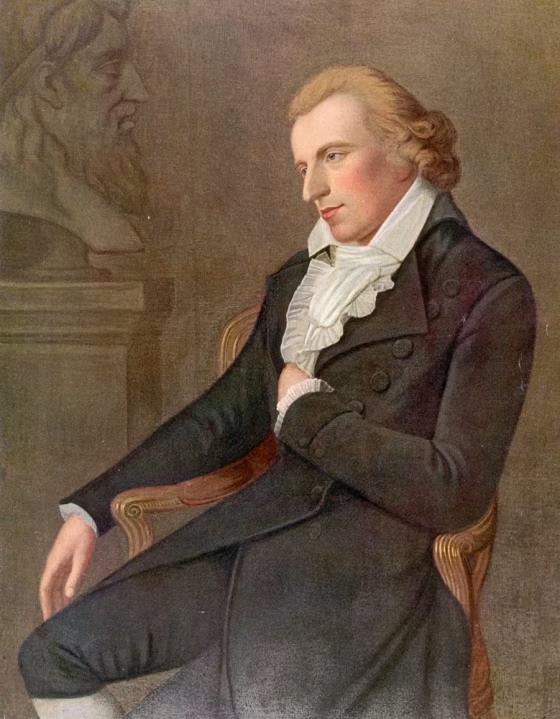
Anthropologists have exhumed the graves of Friedrich Schiller's family in an attempt to positively identify the skull of the German dramatist and poet and end a 180-year-old debate.
"The remains of the bodies were in good enough condition for a DNA examination," said Egon Moehler, a spokesman for the German city of Stuttgart, where the bodies of three relatives who died in the 19th century were unearthed.
To obtain DNA samples for testing, the city has opened the final resting place of the dramatist's eldest son, Carl, his grandson Friedrich as well as the wife of his grandson.

 FOR SUBSCRIBERSCBP leaders cut out of Trump ad buy decision









FOR SUBSCRIBERSA harrowing ordeal aboard an Israel-bound plane





The tests aim to show which of two skulls belonged to Schiller, one of Germany's most celebrated men of letters.
The mystery surrounding the skulls began in 1826, 21 years after Schiller died in Weimar, when the local mayor had 23 skulls retrieved from a mass grave in which the poet was buried. Many eminent people at that time were buried in mass graves.
FOR SUBSCRIBERSCBP leaders cut out of Trump ad buy decision
FOR SUBSCRIBERSA harrowing ordeal aboard an Israel-bound plane
The mayor identified the largest skull as Schiller's and it was brought to the home of his contemporary Goethe, who wrote a poem about it, according to German scholar Albrecht Schoene.
In 1911, another skull was disinterred from the mass grave which researchers claimed was the real one. A long debate amongst academics, historians, medics and anthropologists about the identity of the skulls ensued.
Anthropologists from Berlin and Freiburg initiated the project last year to match the DNA and uncover the truth.