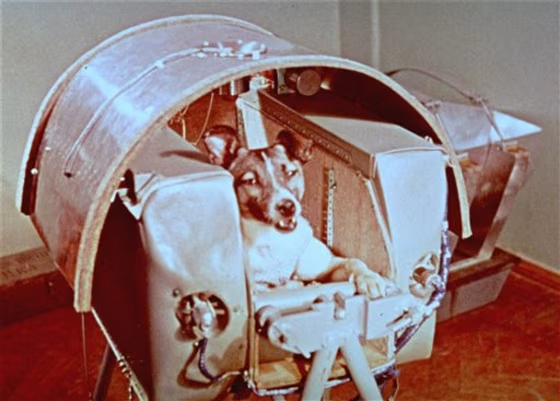
Russian officials unveiled a monument to Laika, a dog whose flight to space more than 50 years ago paved the way for human space missions.
The small monument is near a military research facility in Moscow that prepared Laika's flight to space on Nov. 3, 1957. It features a dog standing on top of a rocket.
Little was known about the impact of space flight on living things at the time Laika's mission was launched. Some believed they would be unable to survive the launch or the conditions of outer space, so Soviet space engineers viewed dogs' flights as a necessary precursor to human missions.
All dogs used in the Soviet space program were stray mongrel dogs — doctors believed they were able to adapt quicker to harsh conditions. All were small so they could fit into the tiny capsules.
The 2-year-old Laika was chosen for the flight just nine days before the launch.
Stories about how she was selected varied: Some said Laika was chosen for her good looks — a Soviet space pioneer had to be photogenic. Others indicated the top choice for the mission was dropped because doctors took pity on her: Since there was no way to design a re-entry vehicle in time for the launch, the flight meant a certain death.
"Laika was quiet and charming," Dr. Vladimir Yazdovsky wrote in his book chronicling the story of Soviet space medicine. He recalled that before heading to the launch pad, he took the dog home to play with his children. "I wanted to do something nice for her: She had so little time left to live," Yazdovsky said.
The satellite that carried Laika into orbit was built in less than one month after the Soviet Union put the world's first artificial satellite into orbit on Oct. 4, 1957.
Due to last-minute technical problems, Laika had to wait for the launch in the cabin for three days. Temperatures were low, and workers heated the cockpit through a hose.







 FOR SUBSCRIBERSA harrowing ordeal aboard an Israel-bound plane







FOR SUBSCRIBERSThe debate over AI’s future rages on both coasts

FOR SUBSCRIBERSA harrowing ordeal aboard an Israel-bound plane
FOR SUBSCRIBERSThe debate over AI’s future rages on both coasts
When Laika reached orbit, doctors found with relief that her heartbeat, which had risen on launch, and her blood pressure were normal. She ate specially prepared food from a container.
According to official Soviet reports, the dog was euthanized after a week.
After the Soviet collapse, participants in the project told the real story: Laika indeed was to be euthanized with a programmed injection, but she apparently died of overheating after only a few hours in orbit.
Several other dogs died in failed launches before the successful space flight — and safe return to Earth — of the dogs Belka and Strelka in August 1960.
After a few other flights with dogs, the Soviet Union put the world's first human _ Yuri Gagarin — into space on April 12, 1961.