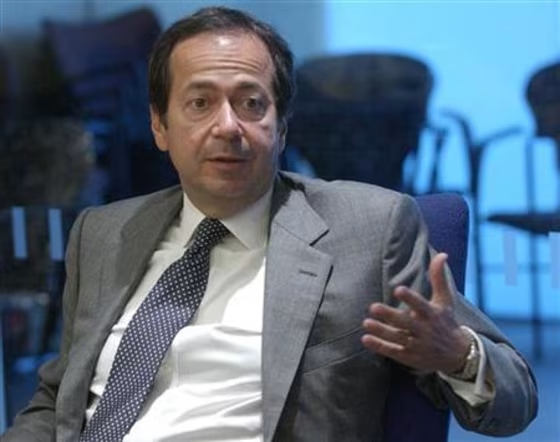
The top hedge fund managers took home dizzying sums last year, fed by a bull market in commodities and investors’ willingness to pay up for proven track records.
Institutional Investor’s Alpha reported Wednesday the top 50 hedge fund managers earned a combined $29 billion in 2007. Five managers earned more than $1 billion.
One contributor to the enormous amounts of money hedge fund managers are making is the unraveling of the traditional “2 and 20” method of compensation. For years, funds typically charged 2 percent of the amount invested plus 20 percent of the profits.
Ezra Zask of Lakeville Capital Management, a hedge fund advisory, said some of the bigger hedge funds are now charging as much as 5 percent of the invested principal and 40 percent of the profits.
Some investors are willing to pay higher fees to funds’ managers if they show they have consistently beaten the market, Zask said.
“Some of these funds have had pretty spectacular returns over the years,” he said.
Further, the growth of the biggest hedge funds has led to higher fees simply because the managers are charging rates on a higher principal.







 FOR SUBSCRIBERSA harrowing ordeal aboard an Israel-bound plane






FOR SUBSCRIBERSThe debate over AI’s future rages on both coasts

Mushrooming prices for commodities such as oil, gold and wheat — which some hedge funds placed bets on — helped fuel profits. The effect of “leverage,” or placing bets with borrowed money, further magnified profits at many funds.
One manager — John Paulson of Paulson & Co. — earned $3.7 billion last year, which management consultant Peter Cohan pointed out means Paulson in 2007 made 30 times in one hour what the median family made all year.
Paulson, who now oversees roughly $28 billion in assets, earned his payout by standing conventional wisdom on its head and betting U.S. housing prices would decline nationally, and that investment-grade mortgage bonds would default in record numbers.
Driven in part by fees hedge fund managers are making, income inequality in 2007 was at the highest level since 1928, the year before the Great Depression began.
FOR SUBSCRIBERSA harrowing ordeal aboard an Israel-bound plane
FOR SUBSCRIBERSThe debate over AI’s future rages on both coasts
In fact, even among hedge funds the disparity has widened, Cohan said: The top 50 managers make a disproportionate share of the fees earned in an industry that by some accounts has 10,000 funds.
The tremendous wealth enjoyed by top hedge fund managers was thrust into the spotlight last year, when Blackstone Group, the hedge fund run by Steve Schwarzman, became a publicly traded company.
Stunned by news stories about Schwarzman’s lavish lifestyle, some members of Congress tried to change laws allowing hedge funds’ profits to be taxed as “capital gains,” at 15 percent, and not income at a rate more than twice that.
Lower taxes notwithstanding, Xavier Gabaix, a finance professor at New York University, said it is not clear whether such gaping inequality is necessarily bad.
Because hedge fund managers make their money by charging fees on investments from rich people, these fees represent the redistribution of wealth from the rich to the very rich, he said.
By contrast, the income inequality plaguing many developing countries represents rich people profiting at the expense of the poor, he said.
Further, Gabaix said the economy may benefit when these managers spend the money they have earned.
Several hedge fund managers have a reputation for philanthropy. According to one report, George Soros — the second-highest-paid hedge fund manager last year at $2.9 billion — has spent $6 billion on philanthropic activities ranging from fighting poverty in Africa to funding universities in Russia.
James Simons, who took home $2.8 billion as manager of Renaissance Technologies Corp., co-founded the Simons Foundation, which finances education and health projects.