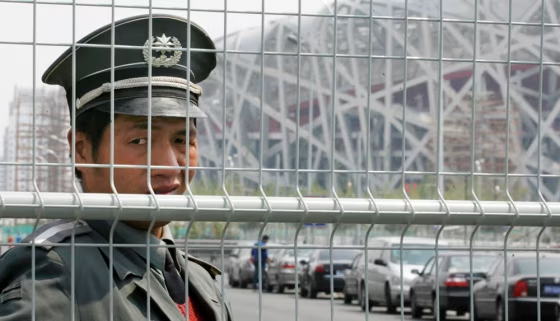
The head of Interpol said Friday that there is a "real possibility" that the Beijing Olympics will be targeted by terrorists or that anti-China groups could attack athletes.
China, whose Communist rulers value stability above all else, have come down hard on anyone they fear could upset the Games, from people protesting against the demolition of their houses for venues to the country's sometimes restless ethnic minorities.
"An attempted act of terrorism is a real possibility and a real concern that all Olympic host countries have shared in recent years," Interpol Secretary General Ronald Noble told the opening of the International Conference on Security Cooperation in Beijing.
"Recent Tibet-related protests have introduced significant additional complications to the normal security considerations for a major international event like these Olympics," he said.
Tibet unrest
The international leg of the Olympic torch relay has been dogged by pro-Tibet and anti-China protests, following unrest in Tibet last month in which China says about 20 people died.
In Japan on Friday, police escorted the flame to the mountain resort of Nagano — where the 1998 Olympics were held — under heavy security after it landed at a Tokyo airport.
The Falun Gong spiritual movement, banned in China as a dangerous cult, held a morning protest in a park near the Nagano train station. In the afternoon, a small group of other protesters waved "Free Tibet" banners.
"In light of recent events, all countries whose athletes will participate and whose citizens will attend the Beijing Olympics must be prepared for the possibility that the groups and individuals responsible for the violence during the global torch relay could carry out their protests at the actual Games," Noble, the police organization's chief full-time official, said.
"These activities could range from disruptive behavior, like blocking major transportation routes or infrastructure or interfering with competitions, to more violent acts like assaulting Olympic officials or athletes or destroying property.







 FOR SUBSCRIBERSA harrowing ordeal aboard an Israel-bound plane







FOR SUBSCRIBERSThe debate over AI’s future rages on both coasts

FOR SUBSCRIBERSA harrowing ordeal aboard an Israel-bound plane
FOR SUBSCRIBERSThe debate over AI’s future rages on both coasts
"Worse yet, we must be prepared for the possibility that al-Qaida or some other terrorist group will attempt to launch a deadly terrorist attack at these Olympics."
China's generally secretive police agencies have sought advice on Olympic security from the United States, Germany, Israel and other foreign governments.
Plots foiled?
Experts say the terrorist threat to China at the Olympics is relatively low, but warn that Beijing faces a growing threat from Islamic separatists among the Uighur population in the western region of Xinjiang.
State media reported in March that a 19-year-old Uighur woman was detained after trying to set a fire in an airplane's bathroom in an attempt to hijack and crash the flight. No one was injured and the plane was diverted.
Authorities have said the attempt was part of a terror campaign to turn the predominantly Muslim Xinjiang into an independent nation called East Turkestan.
Earlier this month, Chinese police announced that they had uncovered a criminal ring that planned to kidnap athletes, foreign journalists and other visitors at the Beijing Games.
A Public Security Ministry spokesman said the "violent terrorist gang" was based in Xinjiang but provided scant evidence. He said another ring uncovered in January was manufacturing explosives and plotting to attack hotels, government offices and military targets in Shanghai, Beijing and other cities.
China has been battling a public relations nightmare as the Olympic torch makes its way around the world before returning to Beijing in May.
At nearly every stop on its trek, the relay has been dogged by protests against China's human rights record, its friendly ties with the Sudanese government and its crackdown in Tibet after anti-government protests turned violent on March 14.
Threat assessments
Since last year, Interpol has been producing threat assessments for China, following up on reports of terrorist and other criminal incidents which could affect the Olympics and conducting training sessions in crisis and major event operations, he said.
An Interpol Major Event Support Team would arrive in Beijing before the Games to train Chinese officers in crisis management and major event operations, Noble added.
"We are also now working with Chinese authorities to implement a system for conducting checks of Interpol's database of more than 14 million stolen and lost travel documents at Beijing's airport and other major border entry points. This is absolutely crucial if we want to prevent terrorists or dangerous criminals from entering China."