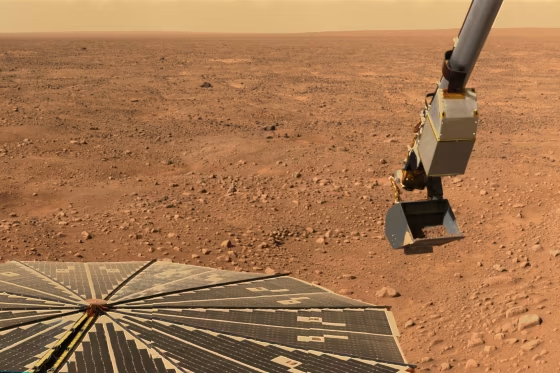
The Phoenix lander stopped digging soil near Mars' north pole Wednesday as engineers on Earth worked to fix a glitch that caused the loss of a day's worth of photos.
The problem was discovered late Tuesday after the spacecraft dug a trench inside a polygon-shaped surface feature that was likely caused by seasonal expansion and shrinking of ice.
The lander beamed back pictures of the trench, but an overload of data prevented it from saving images of the landscape and atmosphere in its flash memory.
Scientists said the lost data wasn't crucial.
"It's unfortunate to lose any bit of science," said mission scientist Ray Arvidson of Washington University in St. Louis. "But it's not really critical stuff that you kick yourself over."
Engineers noticed Phoenix's strange behavior when it sent a piece of engineering data 45,000 times like a broken record. Normally, the lander would store the day's work in its flash memory, but the repeated data caused it to power down for the night without saving everything.
"We're rather annoyed," said project manager Barry Goldstein of NASA's Jet Propulsion Laboratory, which manages the $420 million mission.







 FOR SUBSCRIBERSA harrowing ordeal aboard an Israel-bound plane







FOR SUBSCRIBERSThe debate over AI’s future rages on both coasts

But he said it wasn't debilitating. Engineers overcame the bug, but its cause remained unknown. Wednesday's digging was delayed to not stress Phoenix's memory.
FOR SUBSCRIBERSA harrowing ordeal aboard an Israel-bound plane
FOR SUBSCRIBERSThe debate over AI’s future rages on both coasts
It's the third delay since Phoenix landed in the Martian arctic on May 25 for a three-month mission. The previous work stoppages were caused by relay problems with the two orbiting Mars probes through which Phoenix communicates with Earth.
Before the glitch, Phoenix dug a footlong trench less than an inch deep, but didn't find any of the white material present in deeper trenches. Scientists think Phoenix will reach the white material — possibly ice or salt — as it digs deeper Thursday.
Instead of having the lander store the data overnight, scientists planned to command it to send the information to Earth immediately through the two orbiters.
The project is led by the University of Arizona and managed by NASA's Jet Propulsion Laboratory. The lander was built by Lockheed Martin Corp.