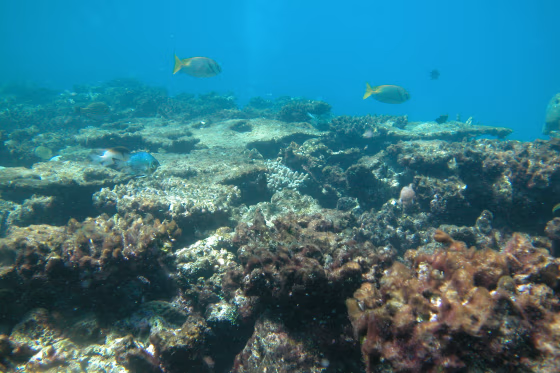
Weakened by impacts that range from global warming to raw sewage, 231 of 704 closely monitored coral species are at risk of extinction and that threat "has increased dramatically in recent decades," experts reported Thursday in the peer-reviewed journal Science.
"Our results emphasize the widespread plight of coral reefs and the urgent need to enact conservation measures," the 39 experts wrote in their report, which was billed as the first comprehensive global assessment of coral.
Their analysis found that 231 species qualify for the "critically endangered," "endangered," or "vulnerable" categories established by the IUCN, a conservation alliance whose experts helped in the analysis.
"The proportion of corals threatened with extinction has increased dramatically in recent decades," they wrote, and "the Caribbean has the largest proportion of corals in high extinction risk categories" — including elkhorn coral, which is listed as critically endangered.
The experts said the downward spiral really took off in 1998 with the start of a series of coral bleaching events — essentially where warmer waters or other factors put stress on coral, which expel the algae living within the coral tissue. The algae provide nutrients and are the reason why corals are so colorful.
Before 1998, they added, only 13 of the 704 species would have been in one of those three categories.
The climate connection
Both global and local factors were blamed for undermining ecosystems that are home to 25 percent of all marine life.
"Globally, rapid build-up of carbon dioxide (and other greenhouse gases) in the atmosphere is leading to both rising sea surface temperatures (with an increased likelihood of mass coral bleaching and mortality) and acidification," the experts wrote.
Oceans naturally absorb some carbon dioxide emissions, and seas are now becoming more acidic as a result, thus reducing the ability of corals to build the skeletons that form the foundation of reefs.
"Reef-building corals are more at risk of extinction than all terrestrial groups, apart from amphibians, and are the most vulnerable to the effects of climate change," stated Roger McManus of Conservation International, whose experts contributed to the study. "The loss of the corals will have profound implications for millions of people who depend on coral reefs for their livelihoods."
"We either reduce our CO2 emissions now or many corals will be lost forever,” added IUCN Director General Julia Marton-Lefevre.
Localized threats
The experts said localized threats include "human disturbances such as increased coastal development, sedimentation resulting (from) poor land-use and watershed management, sewage discharges, nutrient loading and eutrophication from agrochemicals, coral mining, and overfishing."
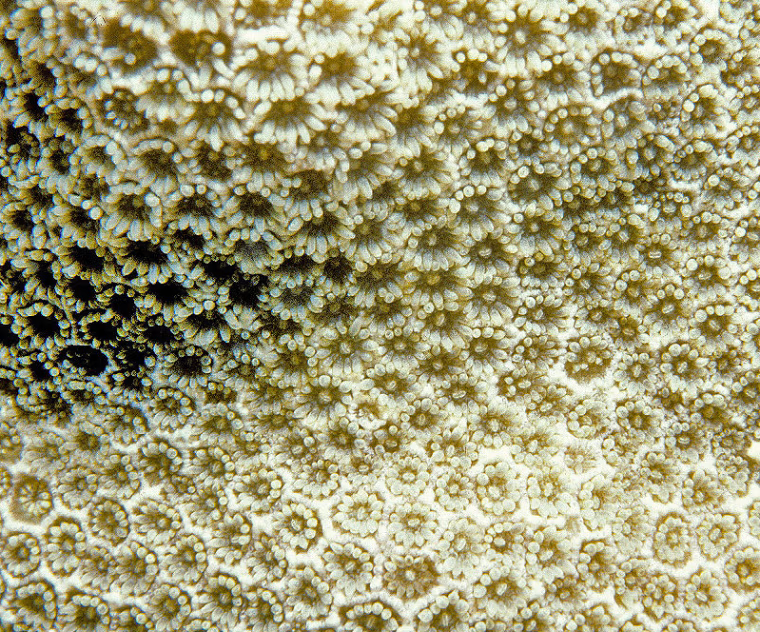
It's in the interest of those local communities to protect their reefs, the experts noted, since they provide income as well as erosion protection from severe storms.
"The results of this study are very disconcerting," stated lead author Kent Carpenter. "When corals die off, so do the other plants and animals that depend on coral reefs for food and shelter, and this can lead to the collapse of entire ecosystems."

 FOR SUBSCRIBERSCBP leaders cut out of Trump ad buy decision









FOR SUBSCRIBERSA harrowing ordeal aboard an Israel-bound plane





FOR SUBSCRIBERSCBP leaders cut out of Trump ad buy decision