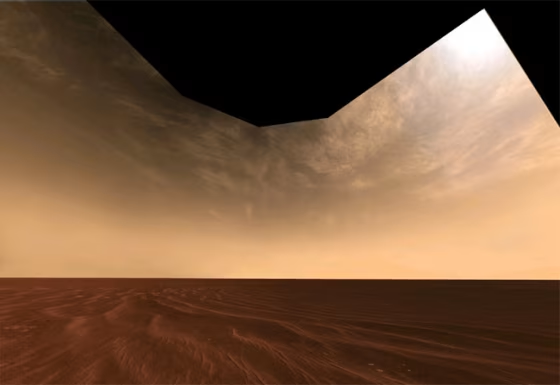
Clouds of water ice drifting above the Martian surface eat up some of the ozone in Mars' atmosphere, a new study suggests, giving scientists new clues about the chemical environment and climate of Earth's nearest neighbor.
Mars has a relatively stable atmosphere that is 95 percent carbon dioxide (Earth's atmosphere is only 0.04 percent carbon dioxide).
Scientists have had a difficult time modeling certain aspects of Mars' atmosphere and some suspected that reactions between atmospheric gases and ice cloud particles could account for the differences between their models and satellite observations, particularly of ozone concentrations.







 FOR SUBSCRIBERSA harrowing ordeal aboard an Israel-bound plane







FOR SUBSCRIBERSThe debate over AI’s future rages on both coasts

Water ice clouds high in Earth's atmosphere are key factors in the loss of ozone above the poles and may perturb the chemistry in layers of air below. Likewise, some scientists thought, similar clouds on Mars could be affecting ozone levels in Mars' atmosphere.
Franck Lefèvre of the Universite Pierre et Marie Curie in Paris and his colleagues used new ozone observations from the European Space Agency's Mars Express satellite, which has been orbiting the red planet since 2003, to test the theory. Their results are detailed in the Aug. 21 issue of the journal Nature.
FOR SUBSCRIBERSA harrowing ordeal aboard an Israel-bound plane
FOR SUBSCRIBERSThe debate over AI’s future rages on both coasts
They included reactions of ozone with destructive chemicals called hydrogen radicals on the water ice clouds, which ironed out some of the inconsistencies observed in the models.
Hydrogen radicals are also important to the recycling of carbon dioxide in the Martian atmosphere, making ozone a sensitive tracer to the chemistry of the atmosphere of Mars.
Subsurface water ice was confirmed to exist in the arctic regions of Mars by NASA's Phoenix Mars Lander on July 31.