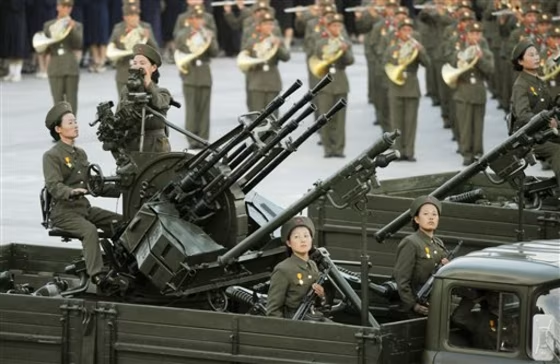
North Korean dictator Kim Jong Il may be gravely ill, perhaps the victim of a stroke, U.S. and other Western officials said Tuesday after he failed to appear for a major national parade. If so, it could jeopardize the already troubled international effort to get his nation to abandon nuclear weapons.
Kim's absence from a military parade for the country's 60th anniversary lent credence to reports that the man North Koreans call the "Dear Leader" had been incapacitated during the past few weeks.
The 66-year-old Kim, who has been rumored to be in varying degrees of ill health for years, has not been seen since mid-August. Though he appears rarely in public and his voice is seldom broadcast, Kim has shown up for previous landmark celebrations.
"There is reason to believe Kim Jong Il has suffered a serious health setback, possibly a stroke," one Western intelligence official said. A senior U.S. official said fresh rumors had been circulating about Kim's health and his control over North Korea's highly centralized government.
Japan's Kyodo News agency reported Wednesday that a senior North Korean diplomat and its No. 2 leader have denied reports that Kim is seriously ill, calling the reports a conspiracy.
Kyodo said Kim Yong Nam, North Korea's No. 2 official, said there was "no problem" with Kim Jong Il. It offered no further details.
Kyodo also said it spoke Wednesday in Pyongyang with Song Il Ho, North Korea's ambassador for normalization talks with Japan, and Song called the reports "worthless" and "a conspiracy plot."
But a former CIA official with recent access to intelligence on North Korea said that even before Tuesday the agency was confident that reports of a health crisis were accurate.
The officials spoke anonymously to summarize sensitive intelligence.
Personality cultThe reclusive Kim took power in 1994 after the death of his father, Kim Il Sung. It was communism's first hereditary transfer of power, and both Kims are revered in a personality cult perpetrated by the country's authoritarian government.
To the outside world Kim is best recognized as a silent, waving figure with a bouffant hairdo and a quasi-military suit reminiscent of communist leaders of an earlier time. Word of his possible health problems recalled the Soviet era, too, when U.S. analysts pored over photos of military parades for clues to who was up and who was down in the Kremlin.
Neither the White House nor the State Department would comment publicly on Kim's health, noting that the North Korean government is one of the most opaque and secretive on Earth.
But U.S. officials said privately they were concerned that Kim's apparently failing health jeopardized six-nation talks aimed at ridding North Korea of its nuclear weapons. The United States has been a wary partner in those talks, but their success is one of the Bush administration's signature foreign policy goals.
A senior State Department official told NBC News that Secretary of State Condoleezza Rice sent her top aide for North Korea, Ambassador Christopher HIll, to Beijing last week in part because of reports that "something might have happened" to Kim Jong-Il.
The official said the intelligence reports on Kim Jong Il's health combined with the fact that the North Koreans were stalling in nuclear talks led Secretary Rice to send Ambassador Hill to consult with the Chinese.
The talks are now stalled in a dispute over the North's obligation to allow intrusive foreign accounting of its known nuclear stockpile.
North Korea's powerful military is known to be opposed to the negotiations with China, Japan, South Korea, Russia and the United States. Many analysts believed the process was continuing mainly due to Kim's support and his backing of moderates in the foreign ministry.
U.S. officials noted that shortly after the health rumors began to circulate in mid-August, North Korea started to adopt a tougher line in nuclear negotiations. The North first suspended disablement of its main nuclear reactor and then threatened to rebuild it, saying the U.S. had not kept a pledge to remove the country from a terrorism blacklist.
Verification scheme stalledThe reactor at Yongbyon was dismantled and its cooling tower blown up in June. In exchange, Washington was to strike North Korea from its list of state sponsors of terrorism but only after Pyongyang agreed to a mechanism to verify that it was abandoning atomic weapons development. The North has yet to agree to the verification scheme.
On Aug. 26, Pyongyang's official news agency reported that the country would "consider soon a step to restore the nuclear facilities in Yongbyon to their original state as strongly requested by its relevant institutions."
Slideshow 36 photos
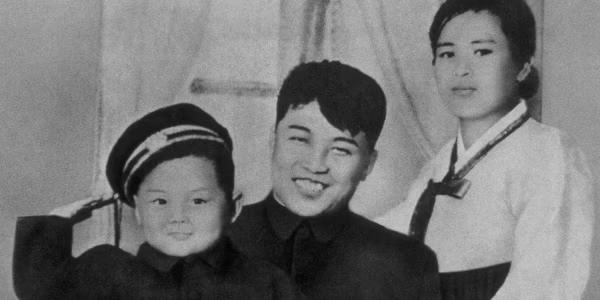
The life of Kim Jong Il
The reference to "relevant institutions" suggested the military may have taken the upper hand and that Kim might no longer be wielding absolute authority.
State Department spokesman Sean McCormack said the United States had recently seen a decline in "outputs" from North Korea on the denuclearization process, particularly on verification.
He added that since last week Pyongyang had been removing equipment from storage near Yongbyon while breaking U.N. seals on other items in what may be preparatory moves to reassembling the reactor.
"Certainly, those steps are not welcome," McCormack said. "Their energy needs to be focused on moving that process forward. Those actions of taking the equipment out of storage, breaking seals, that doesn't move the process forward."
In Seoul, Kim Ho-nyeon, a spokesman at South Korea's Unification Ministry, said Tuesday that officials there had obtained information that Kim's health condition had worsened.
South Korean media have reported in recent days that Kim's condition — South Korean intelligence says he suffers from diabetes and heart disease — may have worsened.
The Chosun Ilbo newspaper, South Korea's largest, said Tuesday that Kim collapsed on Aug. 22.

 FOR SUBSCRIBERSCBP leaders cut out of Trump ad buy decision









FOR SUBSCRIBERSA harrowing ordeal aboard an Israel-bound plane





State media silent North Korea's state media were silent about Kim's absence from the televised parade.
Other key North Korean leaders, most notably the country's No. 2 official, Kim Yong Nam, were shown watching the ceremony at Pyongyang's main square. Kim Yong Nam was quoted by the Korean Central News Agency as telling a banquet later that the country "has a rosy future of a great prosperous powerful nation under the leadership of Kim Jong Il."
Kim's demise could lead to a succession crisis in North Korea. He has three sons by two women but has not designated a successor.
Gary Samore, a former senior official with the National Security Council and now an expert with the Council on Foreign Relations, said he doesn't think Kim's absence would change North Korea's strategy in nuclear negotiations. And he discounted the theory that Kim favored a moderate approach in the talks.
"I think the strategy that Kim Jong Il is following is likely to be pursued by any collective leadership," he said. "They will try to extract as much benefit as possible in the form of money, fertilizer and oil from the west and not give up their nuclear weapons."
Kim's health is one of the most closely guarded secrets in the world's first communist dynasty, but Kim himself, at a summit with South Korea's president in October 2007, dismissed persistent media speculation he was ill.
FOR SUBSCRIBERSCBP leaders cut out of Trump ad buy decision
FOR SUBSCRIBERSA harrowing ordeal aboard an Israel-bound plane
"I make a little move and that gets huge coverage," Kim said in rare comments. "It seems like they're fiction writers and not journalists."
Analysts have cautioned not to read too much into the public appearances of Kim, who can drop out of sight for months and then show up in field guidance tours to military bases, farms and factories for visits described by the North's propaganda machine as showing his tireless devotion to the communist state.
"He may also not wanted to appear because international aid is drying up and the country might have had trouble giving out presents to its people to mark the anniversary," said Shunji Hiraiwa, a professor at the University of Shizuoka in Japan.
Under Kim, the North's already anemic economy has taken a turn for the worse, while the Pyongyang leadership has used the threat of its military arsenal to squeeze concessions out of regional powers.