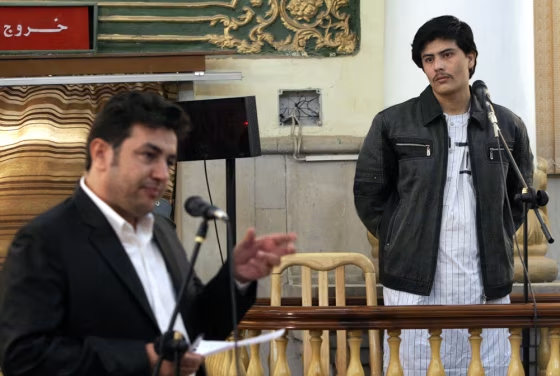
An Afghan appeals court overturned a death sentence Tuesday for a journalism student accused of blasphemy for asking questions in class about women's rights under Islam. But the judges still sentenced him to 20 years in prison.
The case against 24-year-old Parwez Kambakhsh, whose brother has angered Afghan warlords with his own writing, has come to symbolize Afghanistan's slide toward an ultraconservative view on religious and individual freedoms.
"I don't accept the court's decision," Kambakhsh told The Associated Press as he was leaving the courtroom. "It is an unfair decision."
The case can be appealed to the Supreme Court, the highest court in Afghanistan.
Unfair trial?
John Dempsey, a U.S. lawyer working for six years to reform the Afghan justice system, said Kambakhsh has yet to get a fair trial.
"Procedurally, he did not have many of his rights respected," said Dempsey, who attended the trial. "He was detained far longer than he should have been legally held. The defense lawyer was not even allowed to meet the witnesses until a night before the trial."
Kambakhsh was studying journalism at Balkh University in the northern city of Mazar-e-Sharif and writing for local newspapers when he was arrested in October 2007.
Besides the accusation that Kambakhsh disrupted class with his questions, prosecutors also said he illegally distributed an article he printed off the Internet that asks why Islam does not modernize to give women equal rights. He also allegedly wrote his own comments on the paper.
In January, a lower court sentenced him to death in a trial critics have called flawed in part because Kambakhsh had no lawyer representing him. Muslim clerics welcomed that court's decision and public demonstrations were held against the journalism student because of perceptions he had violated the tenets of Islam.
On Tuesday, five witnesses from Mazar-e-Sharif — two students and three teachers — appeared before the three-judge panel.

 FOR SUBSCRIBERSCBP leaders cut out of Trump ad buy decision









FOR SUBSCRIBERSA harrowing ordeal aboard an Israel-bound plane





FOR SUBSCRIBERSCBP leaders cut out of Trump ad buy decision
FOR SUBSCRIBERSA harrowing ordeal aboard an Israel-bound plane
The first witness, a student who gave only one name, Hamid, told the court he had been forced into making a statement accusing Kambakhsh of blasphemy by members of Afghanistan's intelligence service and a professor. He said the professor threatened him with expulsion.
Other witnesses, however, testified that Kambakhsh had violated tenets of Islam.
The head of Tuesday's panel, Abdul Salaam Qazizada, struck down the lower court's death penalty and sentenced Kambakhsh to 20 years behind bars.
'Setback'
The New York-based Committee to Protect Journalists condemned the sentence.
"Even though Kambakhsh's death penalty was overturned, today's sentencing is a great disappointment and a setback for the rights of free expression in Afghanistan," Bob Dietz, the Asia program coordinator for the committee, said in a statement.
The committee said earlier this year it was concerned that Kambakhsh may have been targeted because his brother, Yaqub Ibrahimi, had written about human rights violations and local politics.
Ibrahimi told the AP on Tuesday that his brother was sentenced because of the pressure from warlords and other strongmen in northern Afghanistan, whom he has criticized.