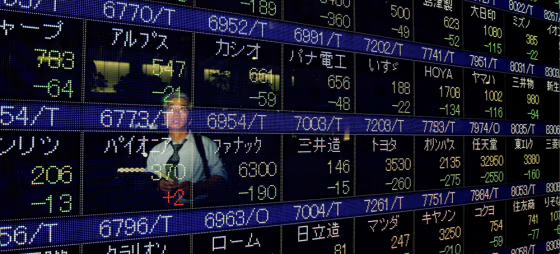
European stock markets opened sharply lower Wednesday following losses in Asia and Tuesday’s reversal on Wall Street amid spreading pessimism over corporate earnings around the world.
Britain’s FTSE 100 index of leading shares was down 128.26 points, or 3.0 percent, at 4,101.47, while Germany’s DAX was down 158.71 points, or 3.3 percent, at 4,625.70. The CAC-40 in France, Europe’s best-performing index on Tuesday, was 105.80 points, or 3.0 percent, lower at 3,369.60.
Europe’s losses echoed those in Asia. Japan’s Nikkei 225 stock average fell for the first time in three days, dropping 631.56 points, or 6.79 percent, to 8,674.69, while Hong Kong’s Hang Seng sank 5.2 percent and South Korea’s main index shed 5.1 percent.
Wall Street fell sharply at Wednesday’s open, with the Dow Jones index down over 200 points in the first few minutes of trading after a host of major companies downplayed their prospects for the coming months.
Fears about the economic outlook around the world have become the markets’ primary concern as worries over the banking system have been assuaged, for now at least, by concerted government attempts to shore up banks, as well as massive liquidity boosts from the world’s leading central banks.
“The credit crunch seems to be behind us, and we are shifting focus to corporate earnings and economic conditions, and clearly both are deteriorating,” said Alex Tang, head of research at Core Pacific-Yamaichi in Hong Kong.
Commodity and oil stocks have been particularly hit in Europe. Mining company BHP Billiton PLC was down more than 6 percent after it warned of uncertain economic conditions in China, the main driver of global economic growth in recent years. Another major mining firm, Anglo American PLC, was also down over 4 percent following BHP’s warning.

 FOR SUBSCRIBERSCBP leaders cut out of Trump ad buy decision









FOR SUBSCRIBERSA harrowing ordeal aboard an Israel-bound plane





Oil stocks were also weighed down by another $2.50 fall in oil prices to $69.67 a barrel despite expectations that the OPEC oil cartel will cut production later this week in an attempt to shore up prices, which have fallen by 50 percent in just three months.
Total SA was down 5 percent, while BP PLC was 4 percent lower.
Repsol YPF SA in Spain was also sharply lower, down 14 percent, over mounting concerns about the state of the Argentine economy. Argentina’s President Cristina Fernandez proposed on Tuesday that the government take over nearly $30 billion in private pension funds, saying retirees must be protected from the global financial crisis. Her move spooked investors and triggered steep falls in Argentine stocks and bonds. Repsol has a large bulk of its business in South America.
FOR SUBSCRIBERSCBP leaders cut out of Trump ad buy decision
FOR SUBSCRIBERSA harrowing ordeal aboard an Israel-bound plane
Some relief to the growing earnings gloom has been provided by the continuing fall in interbank lending rates. Overnight, the Hong Kong interbank offered rate, also known as Hibor, for three-month loans dropped to 3.14 percent from 3.35 percent. Hibor’s continuing declines follow similar falls for equivalent dollar and euro lending.
The rate on three-month loans in dollars slumped 0.23 percentage points Tuesday to 3.83 percent, while the so-called European Interbank Offered Rate for three-month euro-denominated loans fell 0.03 percentage points to 4.968 percent.
Abnormally high interbank lending rates have been the catalyst for the crisis in the financial markets over recent weeks, raising fears they would choke off credit to businesses and individuals.
Earlier, Asian markets suffered as markets fretted about the profit outlook ahead. Particularly hard hit were Japan’s megabanks, which slumped after The Nikkei financial daily reported that Mitsubishi UFJ would miss its net profit projection for the April-September period by about two-thirds due to higher bad loan costs and the falling value of its shareholdings. Mitsubishi UFJ Financial Group Inc. shed 8.8 percent and Sumitomo Mitsui Financial Group Inc. dived 8 percent.
A stronger yen added to the misery in Japan, dragging down exporters such as automakers and consumer electronics firms. A stronger yen reduces the value of overseas profits when repatriated to Japan. Sony Corp. plunged 9.3 percent, Canon Inc. was off 6.1 percent and Panasonic Corp. stumbled 8.4 percent.
In Hong Kong, conglomerate Citic Pacific Ltd. plunged another 25 percent as local securities regulators announced a formal investigation into the company. Shares in the the firm, the Hong Kong arm of the Chinese government’s main investment company, crashed more than 55 percent in the prior session after it revealed HK$15.5 billion (nearly $2 billion) in possible losses due to unauthorized currency bets made by a top executive.
In China, the benchmark Shanghai Composite Index fell 3.2 percent to 1,895.82.
In the currency markets, the euro was down to near two-year lows below $1.30, while the British pound slumped to near five-year lows around US1.63 after Bank of England governor Mervyn King hinted at further rate cuts to come.