The road to Goma wound away from a village teeming with refugees, where babies wailed and mothers shouted for food and money.
Suddenly, an eerie silence. Nothing moved in the lush tropical forest blanketing the hills. A lone soldier came into sight. He was little taller than the rifle slung over his shoulder.
Then, out of a gray haze of dust and tank fumes, a column of soldiers emerged: They were government troops wearing green combat fatigues in full retreat from advancing rebels marching on eastern Congo's provincial capital.
The dirt road into the city of 600,000 people was a scene of chaos Tuesday as rebels continued their relentless march south, sending tens of thousands of terrified civilians into a makeshift shelter as Congolese troops and U.N. peacekeepers retreated.
This reporter traveled with an Associated Press photographer and an APTN cameraman along the route that wound through hills covered in dense tropical forest and deep red soil where bananas grow wild and villagers cultivate maize, cabbages and tomatoes.
Running from violence
In the instant the retreating government troops appeared in the hills outside Kilimanyoka, a group of Uruguayan U.N. peacekeepers in armored cars screamed at us to turn around, waving fingers in a circle.
They motioned for us to pass, but ahead there were government troops in tanks, trucks and jeeps. They bristled when we photographed them, and we felt their sullen anger as we overtook their convoy.







 FOR SUBSCRIBERSA harrowing ordeal aboard an Israel-bound plane







FOR SUBSCRIBERSThe debate over AI’s future rages on both coasts
On two occasions this week rogue soldiers had fired a warning shot over our heads.
Two miles down the red dirt road we stopped at Kibati, where tens of thousands of refugees milled aimlessly, wondering if they would soon have to move on again if the rebels advanced.
Women boiled maize they picked from a nearby field in pots over open fires. Small boys and girls crowded round a village water tank, filling yellow plastic cans.
Constant drone from gunship
Overhead there was a constant drone from a patrolling U.N. helicopter gunship. Babies wailed; little boys fought over a ball. The adults crowded around reporters eagerly.
FOR SUBSCRIBERSA harrowing ordeal aboard an Israel-bound plane
FOR SUBSCRIBERSThe debate over AI’s future rages on both coasts
Sifa Serutsatsi, a pretty 20-year-old student who fled Kibumba, a town she said rebels overran on Monday, told us she wanted to go to Goma but soldiers at a roadblock forced her to turn back.
Jean-Paul Maombi said they don't know where to go. "Will the rebels reach us by Wednesday?" he asked.
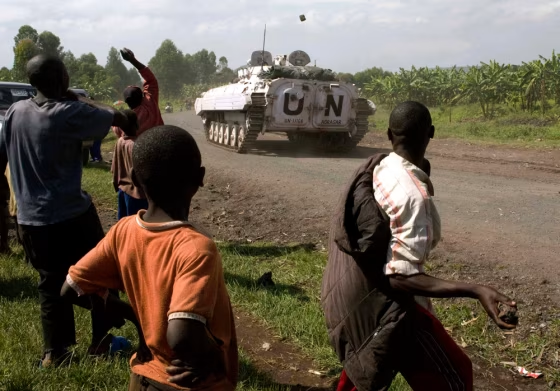
Then he pointed to three white U.N. tanks going in what appears to be the wrong direction — away from the battlefield. Boys and young men started picking up rocks and hurled them at the retreating tanks.
The crowd started hemming in, making loud demands for food, money, cigarettes. "Give me anything," one woman cried.
It was time to go, but not too soon after the U.N. vehicles that have become a target of civilian anger for being unable to offer protection from the rebels.
Safe haven
We were all in the SUV, ready to go. The crowd surrounded the vehicle, but our experienced driver, known to me only as Monsieur Bahati, was calm. He remonstrated with the crowd in the local Kiswahili language: "These people will let the world know that you need help. Don't harass them."
One man wagged his finger at us: "You're part of the problem," he yelled.
Upon entering Goma there was more excitement: Gunshots fired from the direction of the prison. The rumor was that the rebels have arrived. It turned out police had fired to try to stop a revolt in the overcrowded prison.
At last, a haven: The Ihusi Hotel on Lake Kivu with bottles of iced passion fruit juice, a (mostly) working Internet connection, stunning mauve sunsets and Grey Crowned Cranes honking into the night.