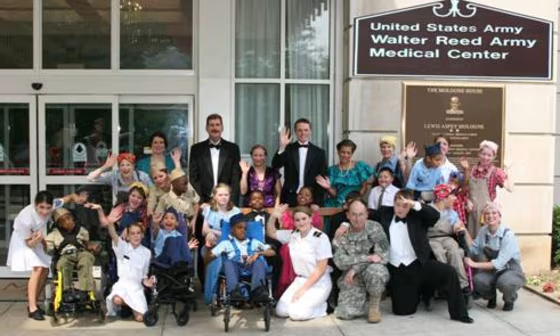
In what’s starting to become a holiday tradition, the kids from the Allegro Foundation are headed to the White House again.
They have been invited to perform Saturday when first lady Laura Bush unveils the White House Christmas decorations. It’ll be their third White House holiday performance in five years.
In December 2004, members of Allegro Foundation … A Champion for Children with Disabilities, as the nonprofit organization is formally known, became the first group of children with disabilities to perform at the president’s official residence.
On Saturday, 10 children with disabilities, along with 10 peer tutors, will be performing movements to such holiday classics as "Frosty the Snowman," "Rudolph the Red Nose Reindeer," and "Chestnuts Roasting Over an Open Fire."
"That's very exciting" for the children, says Allegro founder and spokeswoman Pat Farmer. "Allegro Foundation made history as the first organization in our whole nation's history to perform at the White House, and people were shocked to find that out."
Allegro was founded in 1991 in Los Angeles by Farmer. The foundation moved in 2000 to Charlotte, N.C., a city that lacked resources for children with disabilities. The foundation has served more than 1,200 children with disabilities locally. Farmer says that there are more than 15,000 children with disabilities in the Charlotte area alone.
Performing to inspire
The organization combines movement instruction with educational and medical expertise to teach children with mental retardation, Down syndrome, cerebral palsy, learning disorders and other disabilities. Children with disabilities often participate in movement classes with normally developing kids the same age.
In addition to classes for children with disabilities, Allegro has nursing student rotation programs and a continuing education program that helps teach nursing students and public school teachers how to work with students with disabilities.
Fourteen children and peer tutors from the foundation performed at the Walter Reed Army Medical Center in July 2006 for wounded soldiers returning from Iraq and Afghanistan. Farmer said the performance “touched me in a way that nothing has touched me since … our children with disabilities were performing … giving a sense of hope to our warriors.”
The foundation will dedicate their White House holiday performance this year to all soldiers and veterans.
Allegro’s top priority is education. Jane Fastje, Allegro’s Program/Educational Director, notes that “although the program looks like just fun and games on the surface, the classes are based on a strict and regimented program developed through scientific research and conforming to the educational standards of the local school system.”
“The most important thing is to understand that they are just like you or me, “says Farmer, who believes each of us is born with some form of disability. She says that perception is vital: “It’s how we choose to view it and what we do about it.”
Kids helping kids
Thirteen-year-old Julia de Molina works three times a week with a peer with disabilities in the “Kids Helping Kids” program. De Molina started two years ago and helps at a two weekly classes after school and on Sundays. She says, “We are usually paired up with one kid, and we help them move to the music, help them use the movements and interact with them.”
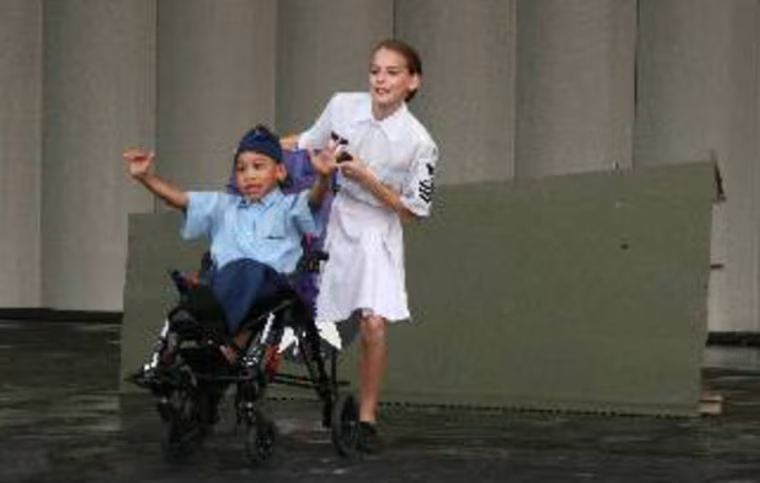
De Molina was one of the peer children who performed at Walter Reed and will be one of the performers at the White House. The Walter Reed performance was so unforgettable that she felt “it will always stick, will never forget it.” At the same time, it taught her to appreciate her own abilities: “I felt really rewarded that I have the abilities that I do.” She says that although they did not get to speak with the soldiers, the children had the chance to “show them the movements… they were all sitting in front of us.”
Michelle Schultze, a child with disabilities, joined Allegro seven years ago and is now 14 years old. She said her favorite aspect of classes was getting “to move and have fun and exercise.” Her favorite memory was when she had the chance to tour the White House, saying that it was “so special.” She will be returning to perform at the White House this year.
A welcoming place
Bob Sisco, whose son Harry has Down syndrome and participates in Allegro’s classes offered at the local hospital and at his school, says the classes offer children like his son a “place to go, where they feel welcome, where they’re not an outcast, where people don’t sit there and point at them or stare at them because they are handicapped.” Bob also stresses, “It is a learning process.”
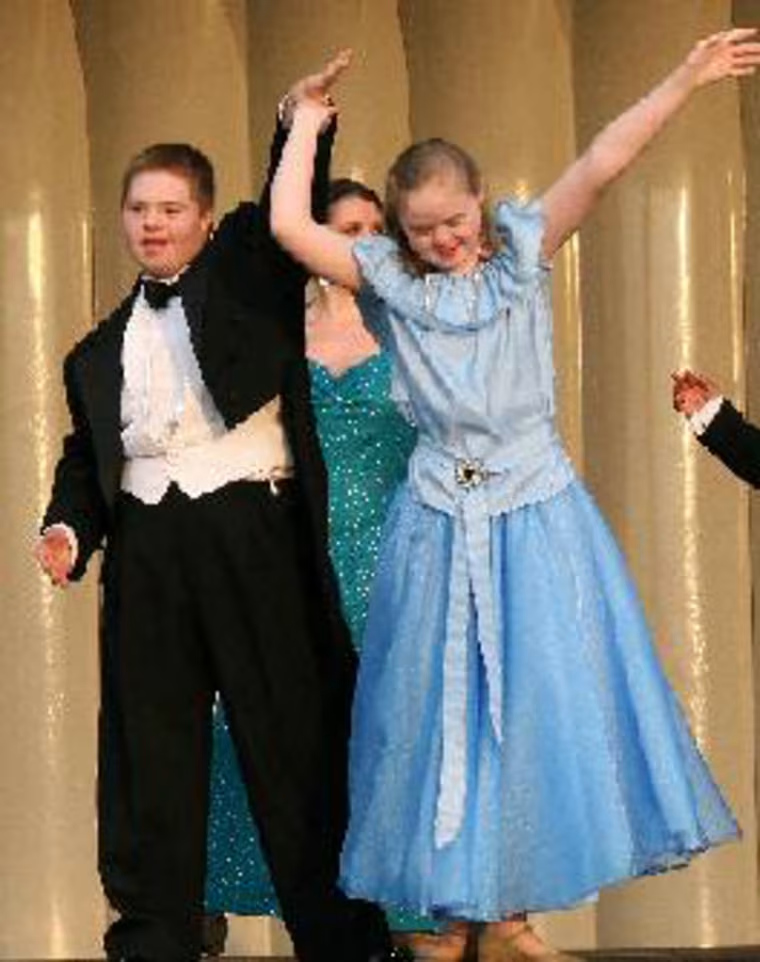
Harry was one of the first children to join the Charlotte program in 2000 when his mother signed him up at age 10. He goes to classes twice weekly for 30 minutes. In math class, Harry and other children would “make their bodies shaped like a number.” Harry also performed at Walter Reed, which was special for Bob and Harry because “it showed them [the soldiers], that they could still do stuff with disabilities.” In his spare time, Harry competes in the local and state level Special Olympics in swimming, soccer, and basketball.
Larry Sprinkle, weather anchor for the morning newscast at the local TV station WCNC 36 in Charlotte, joined the Allegro board of directors in 2003 and also serves as an emcee for Allegro events and as an advocate for their cause. When he first became aware of the foundation, Sprinkle was especially amazed at the progress of the children in classes, “Everything was unlocked for them, and even some with very severe disabilities were able to come out of their shells to contribute.”

 FOR SUBSCRIBERSCBP leaders cut out of Trump ad buy decision







FOR SUBSCRIBERSA harrowing ordeal aboard an Israel-bound plane





FOR SUBSCRIBERSCBP leaders cut out of Trump ad buy decision
FOR SUBSCRIBERSA harrowing ordeal aboard an Israel-bound plane
Sprinkle loves seeing the smiles on the faces of the children when they perform.
“You see in the beginning a very quiet, introverted child. Then, within a short amount of time, you see a beautiful experience happen, when this child is able to express themselves in a way they’ve never expressed themselves before. It may be in a very subtle way, but it’s like a spark of energy.”
Worldwide reach
In 2005, Allegro hosted a delegation of Ukrainian professionals for workshops on the foundation’s methods of helping children with disabilities. Children who were still suffering from the effects of the Chernobyl accident were often not allowed to show their disabilities in public; however, through Allegro’s intervention, these professionals were able to bring back to Ukraine a message of openness.
While Farmer realizes that the current financial climate may make it more difficult for people to contribute, she would like to spread Allegro’s message of awareness for what children with disabilities can do. Farmer is optimistic though as she believes the programs that Allegro offer “will keep Allegro in the future and keep Allegro growing.”