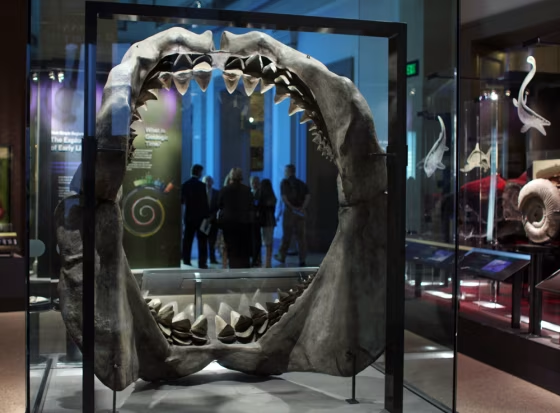
Sharks have wimpy bites for their size and can crunch through their prey only because they have very sharp teeth — and because they can grow to be so big, researchers reported on Tuesday.
Their studies of shark jaws show that lions or tigers win hands down when it comes to jaw strength — but sharks prevail in the water because of their wide jaw size.
"Pound for pound, sharks don't bite all that hard," Daniel Huber of the University of Tampa in Florida, who led the study, said in a telephone interview.
Huber and colleagues had trouble collecting data for their study, "due to the experimental intractability of these animals," they wrote dryly in their report, published in Physiological and Biochemical Zoology.

"The vast majority of the data that went into this study was biomechanical models," Huber said.
They also measured the bites of small sharks such as sand sharks, and tested larger sharks by knocking them out and using electricity to stimulate the jaw muscles.

 FOR SUBSCRIBERSCBP leaders cut out of Trump ad buy decision









FOR SUBSCRIBERSA harrowing ordeal aboard an Israel-bound plane





FOR SUBSCRIBERSCBP leaders cut out of Trump ad buy decision
FOR SUBSCRIBERSA harrowing ordeal aboard an Israel-bound plane
Their conclusions? Sharks can do a lot of damage simply because their teeth are so sharp and their jaws are so wide.
"Our analyses show that large sharks do not bite hard for their body size, but they generally have larger heads," they wrote.
A 20-foot (6-meter) great white shark can "bite through anything that you come across," he adds.
Many must use a sawing motion to break apart their prey, said Huber, whose team studied 10 different species of shark. Mammals have evolved much more efficient jaw muscles, he noted.