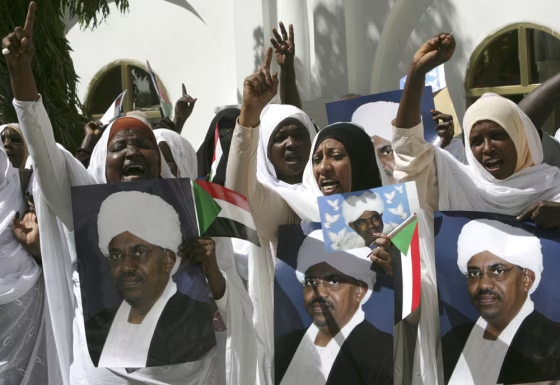
In July 2008, chief prosecutor Luis Moreno-Ocampo asked the International Criminal Court to indict the president of Sudan, Omar al-Bashir, for abuses committed against the people of the Darfur region.
The move set off a firestorm of controversy about whether it would obstruct efforts to bring peace to Darfur. "I cannot adjust to political considerations. Politicians have to adjust to the law," Moreno-Ocampo responded.
After months of debate, the court followed through and on March 4, 2009, indicted Bashir for war crimes and crimes against humanity. Human rights activists heralded the move as a victory for the cause of international justice, but its ramifications for Sudan and its people will take months, if not years, to unfold.
The ICC's warrant for Bashir is the most dramatic development in the global move toward increased transnational justice since the end of the Cold War. The United Nations created several ad-hoc tribunals following the Rwandan genocide and the mass atrocities in the Balkans in the early 1990s. In 1998, the arrest of Chilean leader Augusto Pinochet by British authorities created a precedent for the notion of universal jurisdiction in the view of some legal scholars.
The International Criminal Court came into being in 2002 amid widespread feeling among human rights groups that a permanent body was necessary to address issues of genocide and mass atrocity. Yet international support for the court is still tenuous. The United States epitomizes the mixed global reactions to the ICC -- it has not signed the court's treaty, but it supports the court's work in Sudan. As of March 2009, 108 countries had ratified the court's treaty.
Within Sudan, the ICC indictment has provoked a Among the hundreds of thousands displaced by the crisis in Darfur, there is optimism that the man they accuse of directing a campaign of violence against them might face justice.
Denial in Khartoum
In Khartoum, talk of the ICC case fills television, radio, and print news. The Sudanese government denies the ICC's accusations and claims that Western nations are plotting a regime change. Some analysts believe the case has created divisions within the ruling National Congress Party (NCP). Nobody knows "how big that crack is," Omer Ismail, a Sudanese policy fellow at Harvard's Kennedy School of Government, tells CFR.org. He predicts that the embarrassment of dealing with an indicted ruler may prompt regional powers such as Egypt and Saudi Arabia to encourage a split in the party.
Any weakening in the ruling party could irrevocably upset the fragile balance holding Sudan together. The NCP has fostered inequalities between Khartoum and Sudan's vast periphery that are seen as continuing to feed the conflict in Darfur and the unrest in the south. The Comprehensive Peace Agreement, signed in 2005 with strong backing from the United States, provides a framework for power sharing and wealth sharing between Sudan's north and south. The CPA does not clearly apply to Darfur, however, and one rebel group there has just begun a with Khartoum.







 FOR SUBSCRIBERSA harrowing ordeal aboard an Israel-bound plane






FOR SUBSCRIBERSThe debate over AI’s future rages on both coasts

Amid uncertainty over the impact of an ICC indictment, experts have urged the new U.S. administration to do everything from pressuring the Sudanese president to step down to seeking a deferral of the warrant. The U.N. Security Council has the ability to defer the ICC's warrant for one year.
FOR SUBSCRIBERSA harrowing ordeal aboard an Israel-bound plane
FOR SUBSCRIBERSThe debate over AI’s future rages on both coasts
Ongoing genocide
The International Crisis Group's Nick Grono suggests waiting before making a decision on a deferral. "Given that the indictment of Bashir may itself drive political change within Sudan, the Security Council in particular should set the bar very high, and demand demonstrated progress, before it considers a deferral," he writes in an “International Herald Tribune” op-ed.
The Obama administration's policy toward Sudan has yet to coalesce. New U.N. Ambassador Susan Rice has termed the situation in Darfur "ongoing genocide," and the State Department responded to the March 4, 2009, announcement by saying, "The United States believes those who have committed atrocities should be
Meanwhile, the administration is still assembling its top officials on Africa policy. The National Security Council adviser on Africa, Michelle Gavin, was appointed at the Some expect the appointment of a new special envoy, and one candidate is a prominent activist on Darfur, John Prendergast. He wrote in January that following an ICC indictment, the United States should press for Bashir's resignation, but "the window of opportunity to exact coordinated pressure on Khartoum will not remain open for very long."