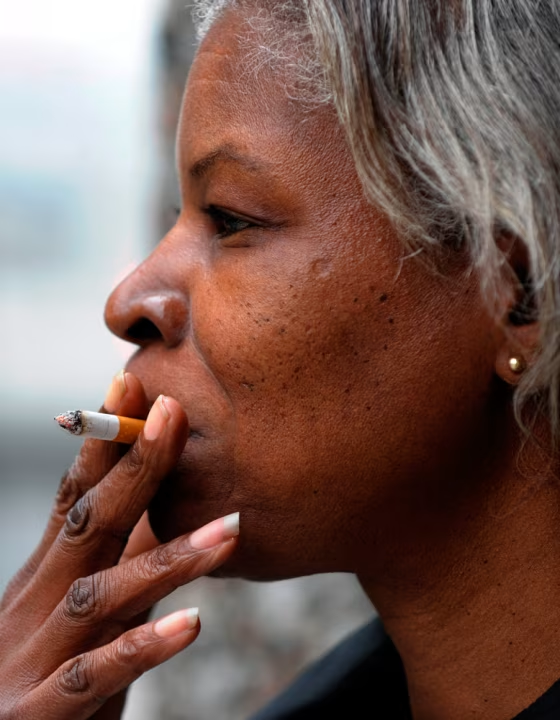
For Tonette Lancaster, it just got to be too much one day -- the worry, the guilt and the money.
"Cigarettes were $6 a pack, and now it's almost $7. It's like a bill," the 30-year-old, half-a-lifetime smoker said yesterday. "I just said, 'Enough is enough.' "
So Wednesday night she slapped on a nicotine patch she got free, along with lots of information and encouragement, from the District government. She hopes it inaugurates a cigarette-free life.
Lancaster, who is studying computer science at a downtown business college, is not alone in her newfound commitment to quit smoking.
In recent weeks across the country, telephone "quit lines" have registered a jump in calls in advance of this week's biggest-ever increase in federal tobacco taxes.
If the past is any guide, the sizable tax boost should have an immediate impact in getting many smokers to quit, and anti-smoking advocates were making the most of the moment yesterday. Much research has shown that smoking is an extremely "price sensitive" habit, with fewer people taking up cigarettes and more people putting them down every time a pack becomes more expensive.
The 62-cent tax increase was adopted this year as a way to fund the expansion of the State Children's Health Insurance Program. On Wednesday, the day the increase took effect, the District's quit line got 131 calls, a record. The same day a week earlier, it had 44 calls; a month earlier, 19.
"I'm in shock, quite frankly," said Debra Annand, director of health education services for the American Lung Association's District of Columbia office, which contracts with the local health department to provide smoking-cessation services.
"Obviously something happened to drive that call volume up," Annand said. "Lots of research has shown the number one thing that helps people quit is increasing the price."
"Several measures are proven to reduce tobacco use. Foremost is taxation," wrote the author of a report two years ago in the Morbidity and Mortality Weekly Report, a publication of the Centers for Disease Control and Prevention.
A national telephone number, 1-800-QUITNOW, connects callers to programs in all 50 states and the District. In March, it registered 203,374 calls, more than twice February's 91,316. In January, it got 76,685.
Normally, February and March have about the same number of calls, and fewer than January, which is a big month for quitting, said Linda A. Bailey, president of the North American Quitline Consortium.
In Washington, the number of calls tripled in March, to 1,757, compared with February. The increases in Maryland and Virginia were more modest -- not quite doubling in March in both states.
Different elements
Various forces are at play in addition to the tax increase.
Virginia recently enacted a law that will ban smoking in most restaurants starting in December. "That may be contributing to some of this," Phil Giaramita, spokesman for the Virginia Department of Health, said yesterday.
Maryland's health department ran 67 quit-smoking spots on two Baltimore television stations in early March, and "we did see a bump" in calls after that, said Sara Wolfe, the state's quit-line coordinator.
Washington also has an advertising campaign underway. A TV spot featuring former Redskin Darrell Green drove Tonette Lancaster to the 800 number.
But the price of cigarettes appears to be the main driver of the recent rise in people seeking help.
Philip Morris raised the price of some brands more than a month ago, and some experts believe it was an attempt by the company to get some profit out of the unavoidable price bump ahead.







 FOR SUBSCRIBERSA harrowing ordeal aboard an Israel-bound plane







FOR SUBSCRIBERSThe debate over AI’s future rages on both coasts

"More so than people not being able to smoke indoors, I am now getting calls from people who say they just can no longer afford to smoke," said Dana Lefko, manager of mission services and advocacy at the American Lung Association's Maryland office.
FOR SUBSCRIBERSA harrowing ordeal aboard an Israel-bound plane
FOR SUBSCRIBERSThe debate over AI’s future rages on both coasts
Although the 62-cent increase is the steepest step-up in federal taxes, it is not the biggest tax increase ever.
New York City increased its local tobacco tax from 8 cents to $1.50 in July 2002, the biggest single jump by any U.S. jurisdiction. Last year, New York state increased its tax on cigarettes to $2.75 a pack.
In 2002, 21.5 percent of New Yorkers smoked -- a proportion that had not changed in a decade. In 2006, after the first tax increase and an ad campaign that graphically described the hazards of smoking, the smoking rate fell to 17.5 percent.
Yesterday afternoon, at a news kiosk near Central Park in Manhattan, a pack of Marlboros was a flat $10.
Cigarette sticker shock tends to fade after a few years, causing the price-driven decline to flatten out. At the lung association's rowhouse office on Seventh Street SE, however, the shock is now in full force, said counselor Robert Wright.
Normally, three or four people wander in off the street each week to ask for help quitting. This week, it's been that many each day.
"I just got a young guy who said he was told a pack cost $8, and he said, 'No way!' " Wright said.
District residents who call the 1-800-QUITNOW number are referred to Wright if they want to enroll in a program. The office follows a strict, evidence-based protocol and provides 10 weeks of nicotine-replacement therapy -- patches or lozenges -- to those who want it.
Nationwide, 28 jurisdictions provide nicotine replacement free. In Washington, clients have to pick up their first two-week supply, and their second, in person.
Which means they need to talk to Wright, a man on a mission. His business card has his cellphone number on it. Most of his clients are low-income -- 60 percent from Wards 7 and 8 -- and he regularly agrees to counsel some at night when their mobile minutes are free.
His required in-person counseling lasts 15 to 30 minutes and includes a carbon monoxide breath test.
‘Greatest motivating part’
Lancaster's test registered 18 parts per million (normal is less than 6) -- enough to tell her that "my lungs aren't operating like they should be," she said, but far below the 63 ppm that one of Wright's clients tested. By the second visit, if a client does not smoke, the number is back down to normal.
"That is the greatest motivating part right there. They are overjoyed -- and so am I," Wright said.
But of course that's not the end. Vigilance is also necessary. In 2007, just 29 percent of people who went through the program quit for good.
Also yesterday, the House approved a measure that would give the federal government the power to regulate tobacco for the first time. The bill, which passed 298 to 112, allows the Food and Drug Administration to regulate some of the ingredients in cigarettes and other tobacco products, along with the products' marketing, but stops short of allowing the agency to ban tobacco. Debate will now move to the Senate.
Staff writers Lyndsey Layton in Washington and Keith Richburg in New York contributed to this report.