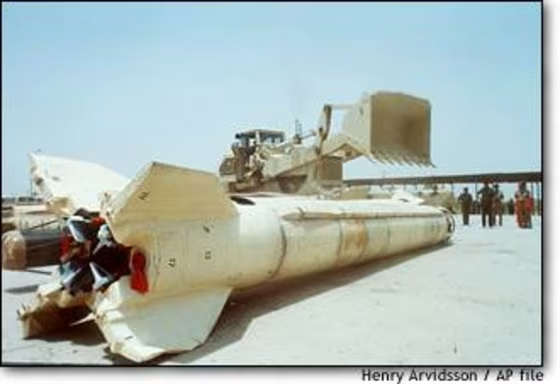
When Saddam Hussein found himself outgunned and overmatched in the 1991 gulf war, he still had one option: The Scud missile. These mobile, ballistic missiles have a range of up to 403 miles and can carry chemical and biological warheads. Iraq launched 90 of these missiles during the Gulf War, doing relatively little damage but sending a message that no attack on Iraq would go completely unanswered.
The medium-range, mobile Scud ballistic missile, developed by the Soviet Union in the 1950s, was widely exported by the Soviets to Iraq, North Korea, Iran, and Libya.
Iraq possessed about 250 imported Scud-type missiles prior to the Gulf War and was also able to manufacture the missiles domestically. It developed different versions, but has mostly used the al-Hussein with a range of 403 miles. The original version had a range of 185 miles.
The al-Hussein’s extended reach puts most of Israel and all of Syria within striking distance.
Lt. Col. Piers Wood (Ret.), a senior fellow at Global Security, calls Scuds an “old technology,” which does not have much potential for upgrades.
“When Russians did not upgrade it, they did so with a reason.” Wood said.
















Yet the presence of Scuds in the Iraqi arsenal has been a matter of concern. The U.N. inspectors in 1996 maintained that Iraq was still concealing six to sixteen enhanced Scud missiles, capable of delivering chemical or biological warheads, and those missiles have still eluded the inspectors.
InsertArt(1830301)The threat that even a few Scuds may have survived post-war U.N. inspections has led to enormous efforts to improve American anti-missile Patriot missile batteries. Israel, particularly stung by the 39 Scuds that hit home in 1990-91, joined with the United States and developed its own, even more sophisticated weapon: the Arrow.
Officials hope that these new systems could prevent Scuds from reaching their targets again. But many remain convinced that 100 percent effectiveness against fast moving missiles is too much to expect.
(Sources: www.fas.org, www.globalsecurity.org)