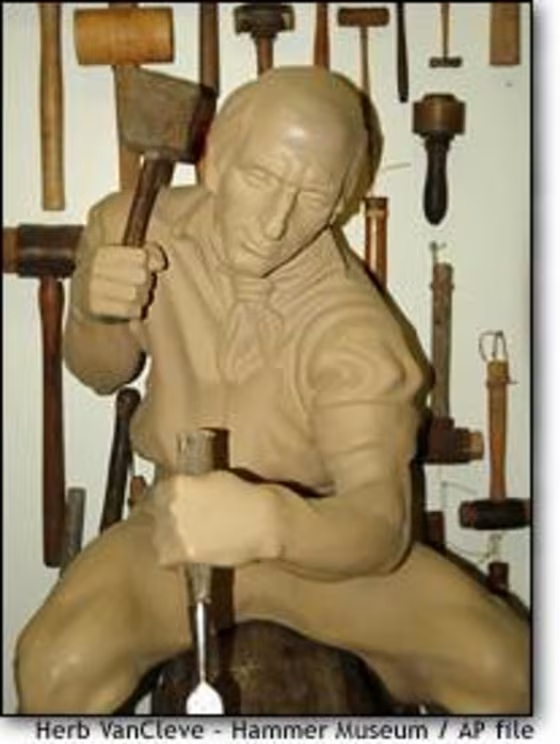
What started innocently enough 30 years ago has turned into a passion that Dave Pahl can’t seem to contain. Not that he wants to. Pahl and his wife, Carol, are the proprietors of The Hammer Museum in Haines, which started modestly last summer when he obtained a small building just up Main Street from the cruise ship docks to display his hammer collection.
HE HAS 1,200 OF THEM: claw hammers, blacksmiths’ hammers, hammers to lay railroad ties, farriers’ hammers and cobbler’s hammers, hammers from the Colonial days and ones from the Industrial Revolution.
“I guess I’m just an incurable collector,” Pahl said.
Pahl, who operates a sawmill and is a longshoreman by trade, discovered that others shared his interest in pounding implements. Every day for seven weeks during the cruise ship season, tourists packed the museum in Haines, a small shipping and timber town of about 1,700 at the northern end of the Alaska Panhandle and about 500 miles southeast of Anchorage.
The museum will open again this year, on May 1.
PIONEER DREAMS
Pahl came to Alaska in 1973 with pioneer dreams that led him to build his own cabin and dabble in blacksmithing.
InsertArt(1867974)“I started to accumulate a lot of tools doing all that,” he said. “After awhile, I had about 100 hammers. There was just something about them that appealed to me. I also found that I could go into places like antique shops and find old hammer heads for, like, 50 cents.”
His collection includes a file maker’s hammer. Before mechanization, wood and metal scraping files were made by hand, with a special hammer and a tiny chisel. A craftsman would make 22,000 whacks with the hammer on the chisel to turn a piece of metal into a half-round, 10-inch file.
He also has a hammer made for hanging posters on the sides of barns.
“It’s got these extensions that you screw together that makes it 6 feet long,” Pahl said. “It’s got these clips on the end to hold the nail and an attachment to hold the rolled up poster; so you just whack in the nail and there you go.”
And then there’s the hammer that bankers used to cancel checks in the 1800s.

 FOR SUBSCRIBERSCBP leaders cut out of Trump ad buy decision









FOR SUBSCRIBERSA harrowing ordeal aboard an Israel-bound plane





At the museum this season, mannequins will be wielding some of the hammers.
FOR SUBSCRIBERSCBP leaders cut out of Trump ad buy decision
FOR SUBSCRIBERSA harrowing ordeal aboard an Israel-bound plane
The five hollow fiberglass male mannequins come from the Smithsonian Institution’s National Museum of American History. The Pahls visited the museum over the winter.
TRAVELED IN PIECES
The Smithsonian’s curator, after hearing about The Hammer Museum, offered the mannequins, which had been in storage since the 1960s.
“I guess it just turned out to be good timing,” said Carter Tatum, a spokeswoman from the American History museum. “We were very happy to pass them along.”
Instead of paying nearly $3,000 to get the mannequins professionally packed and shipped north, Pahl sawed the men into pieces and packed and mailed them himself. When they arrived at his museum, he put them back together, repairing details with papier mache.
The fiberglass men dressed in colonial garb today are posed in a blacksmith’s shop, at a shoemaker’s bench and at a sawyer’s workbench, all holding some of Pahl’s hammers.
Pahl didn’t charge visitors to the museum last year, although he may this season. He’d at least like the museum to pay its own way, earning enough to cover utilities and maintenance expenses.
But caring for his collection gives him something interesting to do, especially during the long Alaska winters, spending time repairing rotted handles or researching backgrounds on the histories of his pieces.
“And I’ll always take more hammers,” he said.© 2003 Associated Press. All rights reserved. This material may not be published, broadcast, rewritten or redistributed.