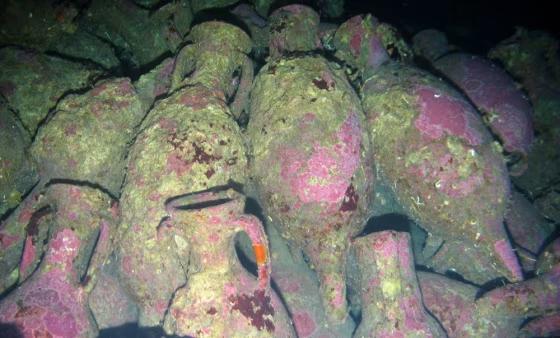
A team of archaeologists using sonar technology to scan the seabed have discovered a "graveyard" of five pristine ancient Roman shipwrecks off the small Italian island of Ventotene.
The trading vessels, dating from the first century BC to the fifth century AD, lie more than 100 meters underwater and are amongst the deepest wrecks discovered in the Mediterranean in recent years, the researchers said on Thursday.
Part of an archipelago situated halfway between Rome and Naples on Italy's west coast, Ventotene historically served as a place of shelter during rough weather in the Tyrrhenian Sea.
"The ships appear to have been heading for safe anchorage, but they never made it," said Timmy Gambin, head of archaeology for the Aurora Trust (www.auroratrust.com). "So in a relatively small area we have five wrecks...a graveyard of ships."
The vessels were transporting wine from Italy, prized fish sauce from Spain and north Africa, and a mysterious cargo of metal ingots from Italy, possibly to be used in the construction of statues or weaponry.
Gambin said the wrecks revealed a pattern of trade in the empire: at first Rome exported its produce to its expanding provinces, but gradually it began to import from them more and more of the things it once produced.
In Roman times Ventotene, known as Pandataria, was used to exile disgraced Roman noblewomen. The Emperor Augustus sent his daughter Julia there because of her adultery. During the 20th century, Italian dictator Benito Mussolini used the remote island as a prison for political opponents.

 FOR SUBSCRIBERSCBP leaders cut out of Trump ad buy decision









FOR SUBSCRIBERSA harrowing ordeal aboard an Israel-bound plane





Images of the wrecks show their crustacean-clad cargoes spilling onto the seafloor, after marine worms ate away the wooden hull of the vessels.
FOR SUBSCRIBERSCBP leaders cut out of Trump ad buy decision
FOR SUBSCRIBERSA harrowing ordeal aboard an Israel-bound plane
Due to their depth, the ships have lain untouched for hundreds of years but Gambin said the increasing popularity of deep water diving posed a threat to the Mediterranean's archaeological treasures.
"There is a race against time," he said. "In the next 10 years, there will be an explosion in mixed-gas diving and these sites will be accessible to ordinary treasure hunters."
More about shipwrecks | ancient Rome