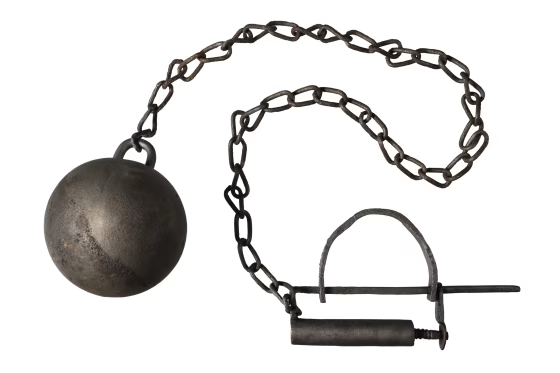
An iron ball and chain found on the banks of London's River Thames is causing a stir among archaeologists who say the 300-year-old artifact used to restrain convicts on ships may have a gruesome story to tell.
The leg irons, believed to date from the 17th or 18th century, were pulled from the mud with the lock fastened, suggesting a convict could have drowned while trying to escape.
The prospect conjures up a tantalizing tale reminiscent of the work of 19th-century Victorian author Charles Dickens, said Museum of London archaeologist Kate Sumnall, who examined the find.
"Whether a real-life 'Magwitch' freed himself from the 'great iron on his leg,' or perished in shackles, or whether this ball was simply discarded, we can never know," she said.
Abel Magwitch is a character in "Great Expectations" — a violent convict who escapes from a prison ship.
"Nothing like this has ever come across my desk before," Sumnall said, adding that to find a complete set of irons was very rare.
She said valuable, high-quality iron was used to make the ball and chain, suggesting that it was unlikely to have been discarded.
"And we also know from the lock design that it was not a slave ball and chain," she said.
The padlock is skillfully made, with the screw-thread carved after the padlock had been cast. English padlocks of this time were not made in this way, suggesting it was made somewhere in continental Europe, possibly Germany.
The long spike on the padlock would have pointed toward the other leg when it was fitted around the ankle, Sumnall said.

 FOR SUBSCRIBERSCBP leaders cut out of Trump ad buy decision









FOR SUBSCRIBERSA harrowing ordeal aboard an Israel-bound plane





FOR SUBSCRIBERSCBP leaders cut out of Trump ad buy decision
FOR SUBSCRIBERSA harrowing ordeal aboard an Israel-bound plane
The device, which weighs about 18 pounds (8 kilograms), was preserved by the thick black mud of the Thames, whose anaerobic properties protect metal, ceramic and even leather finds exceptionally well.
The fetters were found by "mudlarks" Steve Brooker and Rick Jones on the Thames foreshore, close to a wharf in Rotherhithe in southeast London.
Mudlarks, history enthusiasts who have sometimes been likened to amateur archaeologists, have special permits to search and dig the foreshore from the Port of London Authority.
Digging on the north side of the Thames between Westminster in central London and Wapping in the east of the city is typically prohibited because it is so rich in archaeological deposits.
There are only 51 "official" mudlarks who have achieved this recognized status — through the Society of Thames Mudlarks — by recording their finds through institutions such as the Museum of London.
Many have become experts in periods of English history through the many thousands of historical artifacts they unearth.
The ball and chain are on display in the foyer of the Museum of London Docklands for a limited time.