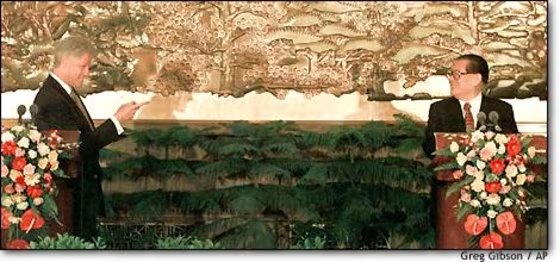
For those of you who see the world in terms of black and white, good versus evil, us versus them, it was a very disturbing weekend. Here was the American president, denounced by his critics as a “traitor” just three weeks earlier, telling a national television audience in China they should demand liberty and justice, thus doing more to advance human rights than all the single-issue zealots in Washington combined.
HOWEVER MUCH HONEST people might disagree over Bill Clinton’s presidency, it is important to understand that the message of individual rights and liberty broadcast all over China this weekend cannot be undone by its communist regime. It can’t be jammed or erased from people’s memories. Nor, judging from the lame response of President Jiang Zemin to Clinton’s criticisms, can they be explained away.
What happened was extraordinary — a seed that will grow and ultimately overwhelm those who think they can continue to define “human rights” as a synonym for “one party state.” And none of it could have happened without a policy of engagement. The debate on whether to “engage” or “contain” China, a debate given an unwarranted second life by the Clinton administration’s bumbling over satellite launches, has now been settled.
THE EMPEROR HAS NO CLOTHES
It may be difficult for someone in the media-saturated developed world to understand the enormity of a live televised debate on human rights or the status of Tibet or Taiwan in a country like China. We have the luxury of complaining about the American media’s obsession with “going live,” with all the lack of polish and perspective that implies. And yet, in China it is almost unknown. When Nixon went to China in 1972, nothing was broadcast live. Only last year, when Jiang Zemin visited the United States, all Chinese television coverage was taped and carefully edited. No mention of controversy was let through, let alone a dialogue on national taboos or the communist party’s “leading role” in politics.
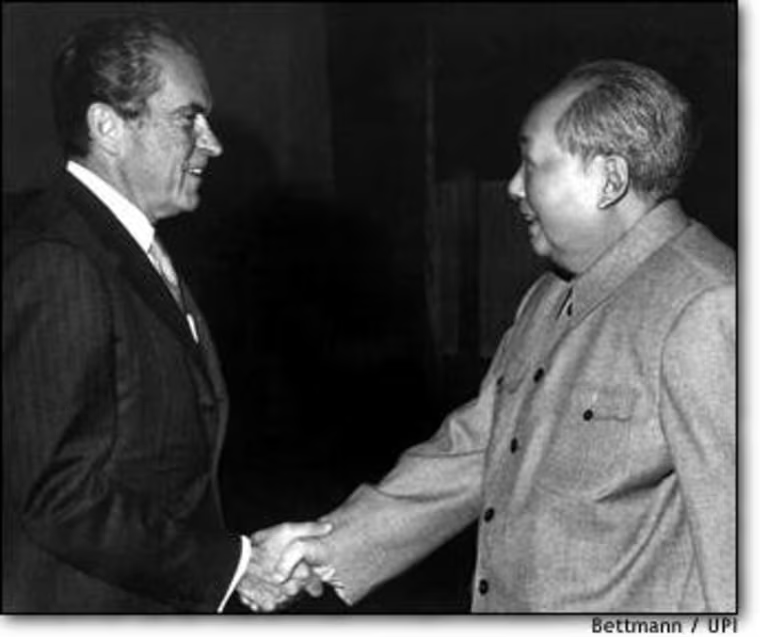
Into this atmosphere Clinton has now injected the idea that China’s leader cannot crush all dissenting voices. Even those in China who may disagree with some of the president’s points on Tibet or Taiwan cannot have missed the empty, legalistic responses of their president. The emperor has no clothes. Irony of ironies, it was Clinton who undressed him.
It is not a great leap forward from that point to Bucharest in 1989, when hecklers shouted down Romania’s Nicolae Ceausescu when he tried, on live television, to let the people know he was still the boss. A few days later — again on live television — Ceausescu and his wife were stood against a wall and shot.

 FOR SUBSCRIBERSCBP leaders cut out of Trump ad buy decision









FOR SUBSCRIBERSA harrowing ordeal aboard an Israel-bound plane





FOR SUBSCRIBERSCBP leaders cut out of Trump ad buy decision
FOR SUBSCRIBERSA harrowing ordeal aboard an Israel-bound plane
China won’t go that route and for the sake of Asia’s stability and the world’s, no one should be wishing it. But what communist regime has survived a live, televised humiliation similar to the one inflicted on Jiang Saturday? Gorbachev? Honecker?
Only one such dictator has survived that I can think of: Fidel Castro, the Cuban president eviscerated by Pope John Paul II during his visit there last January. Of course, Castro has an advantage: Being “isolated” by precisely the kind of backward-thinking policies that Beijing’s supposed enemies now advocate for China, Castro can blame any and all hardships in Cuba on the United States. This is the fruit of “isolation.”
THE ISOLATION MYTH
And what a favor it would be to China’s hard-liners, too. Imagine what would flow from a policy of isolation: purges of those within China’s Communist party who had advocated opening up; the rise of China’s nationalist faction — precisely the faction most likely to seize Taiwan, to seek trouble with India or Russia and thus involve the U.S. in another war. Meanwhile, Europe and possibly Japan as well would keep China’s economic engine well-oiled.
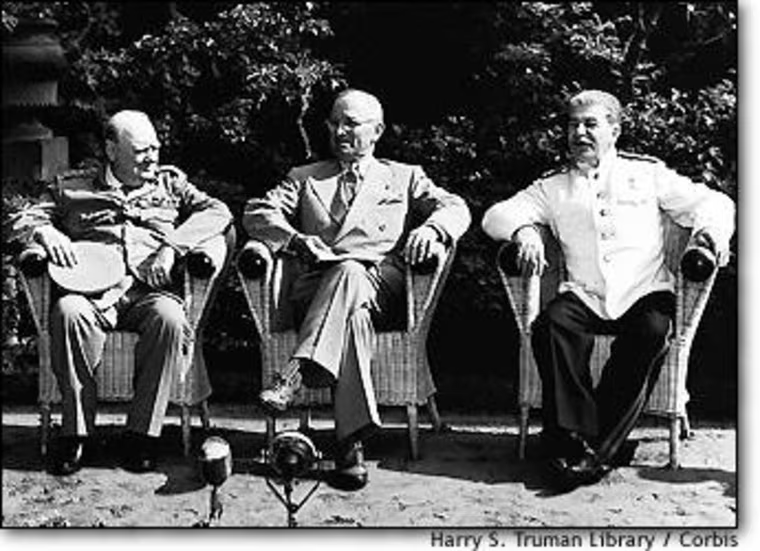
As hard as it may be for China’s enemies here to admit, there are degrees of evil when it comes to authoritarian regimes and China’s has been moving down the scale, not up, for over a decade. This was never true of Ceausescu’s Romania, (a fact that didn’t stop Nixon from visiting the murderer’s palace in 1967) nor was it the case in the Soviet Union until Gorbachev came to power. Did isolating the Soviet Union make sense? Of course not. Franklin Roosevelt figured that out in 1933, and was damned glad of it by 1945.
The West is right to be unhappy with the pace of political change in China. The arrests of dissidents should be denounced and China’s name publicly rebuked every time it happens. The West should remain vigilant with regard to nuclear and ballistic missile transfers, reports of forced abortions, ethnic or religious persecution.
But the West will never right those wrongs. As in Romania, as in the Soviet Union and in every communist state in between, it ultimately fell to the people to put their own houses in order.
FORGET THE MESSENGER
Of course, there will be some — a minority — who can’t get beyond the fact that Clinton was responsible for the past weekend’s successes in China. That is too bad. For while it is fine to loathe the man for his draft-dodging or his alleged sexual peccadilloes or his blow-dried hair, it is wrong to allow your feelings about Clinton, the individual, to obscure what Clinton the president achieved this weekend. An American president on Saturday stood next to China’s president and told the Chinese people they should not accept the abuses of their communist government. He told them his presence does not imply that Americans have forgotten the brutality of Tiananmen Square, the misrule of Tibet or the round-ups of clerics and political dissidents that proceeded even as he spoke. To the American ear, ruined by the hyperbole of television politics, this may have sounded like “walking on eggs,” as one detractor put it. But to a potential audience of 1 billion Chinese, this would have been astounding.
And what response from President Jiang Zemin? Here’s a short sample of his cunning comebacks:
On arrested dissidents: “I do not have very detailed information in this regard.”
On the right to dissent: “The Chinese people ... can fully express their views and exercise their political rights.”
On Tibet: “In 1990, when I was in Tibet, I went to visit the liberated serfs.”
On free expression: “In China’s constitution, it is clearly stipulated that the Chinese citizens have the freedom of speech.”
Oh yes, that last one was a real winner — a billion Chinese belly laughs. I’m sure it fooled them all.
Without engagement, none of this happens.