
Ten years after an Air France Concorde crashed, killing 113 people and foreshadowing the end of the jet that embodied elegance at supersonic speed, a French court on Tuesday begins probing an elusive question: Who was to blame?
The trial in Pontoise, north of Paris, could last four months as the court debates who should be held responsible for the July 25, 2000 crash of the jet, which plunged into a hotel minutes after takeoff from Charles de Gaulle airport, trailing a tail of flames.
Houston-headquartered Continental Airlines, Inc. and two of its U.S. employees are among those on trial for manslaughter.
Investigators have long argued that the crash was triggered by a metal strip lying on the runway that had fallen from a Continental DC-10 minutes before.
Continental's lawyer plans to argue the plane caught fire before it reached the debris and says the American company was a convenient scapegoat.
Pride of commercial aviation
Besides pointing at Continental, the prosecution also accuses French officials of neglecting to fix known design weaknesses in the jet.
The Concorde, capable of flying at twice the speed of sound, was the pride of commercial aviation — though never a financial success — before both Air France and British Airways retired it in 2003.
Two others on trial for manslaughter were employed by Aerospatiale, the precursor of plane-maker Airbus, while the fifth is an employee of the French civilian aviation authority.
Their lawyers say they were not to blame and argue the crash could not have been predicted.
As the trial opened, several lawyers said they had asked the court to call off the proceedings on a technicality.
Olivier Metzner, the lawyer for Continental, and Daniel Soulez Lariviere, representing longtime aviation official Claude Frantzen, said the document ordering the trial failed to provide counterweights to the accusations against their clients, as is required.
Compensation not a major issue
The crash killed 109 people on the plane, mostly German tourists, and four people on the ground.
Compensation is not a major issue in the trial, and most of the victims' families received settlements long ago.
Most have also remained silent and are not taking part in the proceedings, though family members of pilot Christian Marty are civil parties, with their lawyer saying they want answers.
In the years after the Concorde crashed, both French aviation and judicial investigators concluded that the Continental DC-10's metal piece — known as a wear strip — gashed the Concorde's tire, sending pieces of rubber into the fuel tanks, which caused a fire.
Continental lawyer Metzner says he plans to present testimony from about 20 witnesses who say they spotted a small fire aboard the Concorde before it reached the metal strip.
Fuel tanks lacked sufficient protection
He says the Concorde had trouble spots and says that particular plane was overloaded and took off missing a piece to stabilize the wheels.
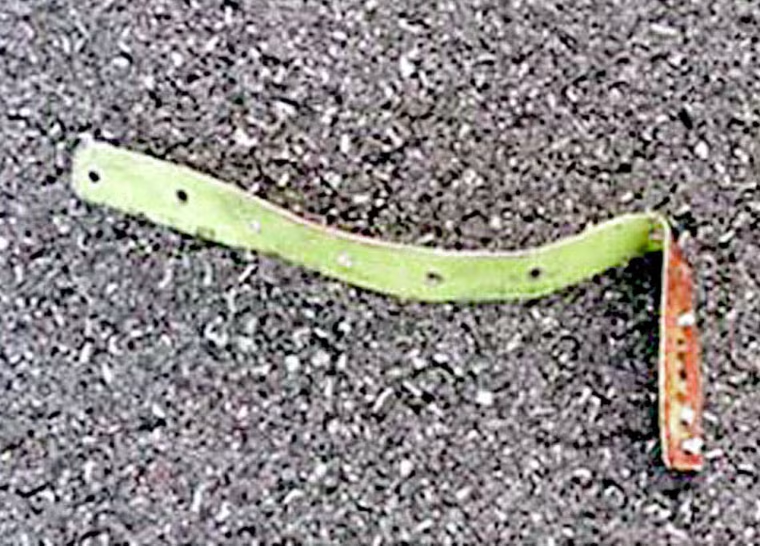
Continental mechanic John Taylor, 41, is accused of violating guidelines by replacing the DC-10's wear strip with titanium instead of the softer metal usually called for, aluminum.
Maintenance chief Stanley Ford, 70, is on trial for validating the strip's installation.







 FOR SUBSCRIBERSA harrowing ordeal aboard an Israel-bound plane







FOR SUBSCRIBERSThe debate over AI’s future rages on both coasts

FOR SUBSCRIBERSA harrowing ordeal aboard an Israel-bound plane
FOR SUBSCRIBERSThe debate over AI’s future rages on both coasts
French aviation investigators deemed the chain of events that led to the crash unpredictable.
But a French judicial inquiry determined that the plane's fuel tanks lacked sufficient protection from shock, and that officials had been aware of the problem since a series of incidents in 1979.
The three other men accused of manslaughter in the case are Henri Perrier, 80, ex-chief of the Concorde program at plane maker Aerospatiale from 1978 to 1994; Jacques Herubel, 74, a top Aerospatiale engineer at Concorde from 1993-95; and Frantzen, 72, who handled the Concorde program in various roles at the French civil aviation authority.
Manslaughter charges can carry penalties of up to five years in prison and a euro75,000 ($104,000) fine, but observers say suspended prison sentences are more likely in this case.