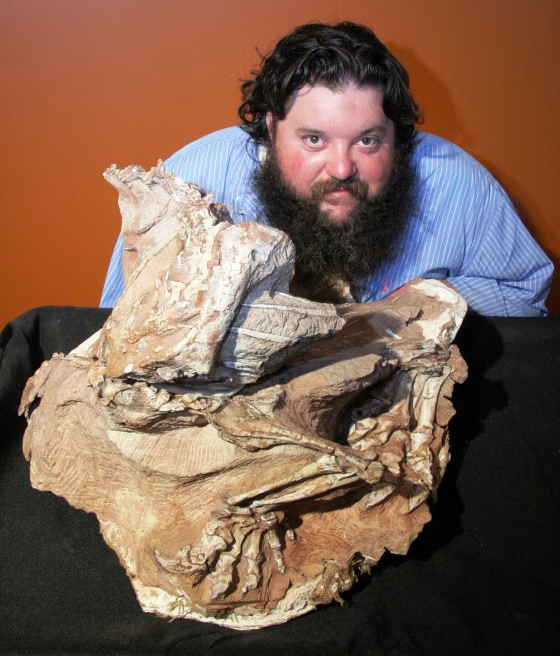
A new species of dinosaur has emerged from the rocks of southern Utah.
Buried by a collapsing sand dune, perhaps 185 million years ago, the new dino was probably a plant eater and an early relative of the giant animals later known as sauropods, researchers report in Tuesday's edition of the journal PLoS One.
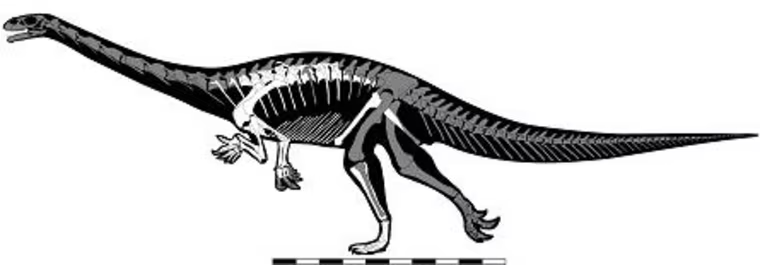
Named Seitaad ruessi, the species was 10 to 15 feet (3 to 4.5 meters) long and 3 to 4 feet (1 meter) high. Its bones were found protruding from sandstone at the base of a cliff, directly below an ancient Anasazi cliff dwelling.
No humans were around at the time of the dinosaurs, but researchers say the bones could well have been visible when the early Indians lived there.
The name Seitaad comes from the word "Seit'aad," which was a sand monster that buried its victims in dunes in Navajo legend, according to the researchers. The newly named skeleton had been swallowed by a sand dune.
So, might visible dinosaur remains have given rise to the ancient Indian monster legend?
"That's a lot of speculation, but anything's possible," said Mark Loewen, a paleontologist at the Utah Museum of Natural History and instructor in the Department of Geology and Geophysics at the University of Utah.
One of the Anasazi dwellings included a stone with a dinosaur footprint in its center, he noted.
The ruessi part of the name is in honor of poet and naturalist Everett Ruess, who disappeared in southern Utah in 1934.
Understanding how dinosaurs lived in the past, how their environments changed and affected them, is important for understanding our changing world today, Loewen said.
The nearly complete skeleton is missing only its head, one toe and a lower shinbone, he said, noting that erosion over the years probably accounts for the missing parts.
What the researchers have is similar to other sauropodomorphs found in South America and southern Africa, which were all vegetarians, he explained in a telephone interview. However, Seitaad did have a claw on its front limbs, which Loewen suggested was probably used for defense.
"We were absolutely shocked" by the discovery of this dinosaur, Loewen said. It was found in 2004 by a local artist studying rock paintings and the scientists went to the area immediately when they learned of it, he said. The bones were excavated the following year by museum researchers.
While dinosaur remains have been found in other parts of Utah, fossils are rare in the Navajo sandstone areas and generally have been from smaller creatures.

 FOR SUBSCRIBERSCBP leaders cut out of Trump ad buy decision









FOR SUBSCRIBERSA harrowing ordeal aboard an Israel-bound plane





FOR SUBSCRIBERSCBP leaders cut out of Trump ad buy decision
FOR SUBSCRIBERSA harrowing ordeal aboard an Israel-bound plane
"This new find suggests that there may be more dinosaurs yet to be discovered in these rocks," said Joseph Sertich, co-author of the report and currently a doctoral student at New York's Stony Brook University.